Your Grow Guide
2×4 tent · coco + Amphibious drip · EVO3 · 2 plants
Tap the step you’re on.
jump ›🌡️VPD chart & calculatorYour targets by stage · type temp + RH, get VPD at the leaf›
By stage
Built at offset 0 — what that means
Your rig, your studio. Built at offset 0 — leaf treated as the same temperature as air, which is exactly what your Controller AI+ is doing until you set otherwise.
| Stage | Aim tent | VPD | @72° | @76° | @80° | @84° |
|---|---|---|---|---|---|---|
| Seedlingwk 1–2 | 75–80°F | 0.5–0.8 | 70–81% | 74–84% | 77–86% | 80–87% |
| Vegwk 3 → flip | 75–82°F | 0.9–1.2 | 55–66% | 61–71% | 66–74% | 70–77% |
| Stretchfirst 2 wk of 12/12 | 75–80°F | 1.1–1.3 | 51–59% | 58–64% | 63–69% | 67–72% |
| Flowerwk 3–7 | 74–79°F | 1.3–1.5 | 44–51% | 51–58% | 57–63% | 62–67% |
| Ripenlast 2 wk | 68–76°F | 1.4–1.6 | 40–48% | 48–54% | 54–60% | 60–65% |
Reading the % columns · why some are amber
The last four columns are the humidity that holds that VPD at that air temp — the same instruction said three ways, so the rows can never argue with each other. Amber = your studio winning: at 80–84°F, holding flower VPD needs humidity high enough to invite bud rot. That’s your signal to cool the tent, not to chase the number.
Which way does your leaf sit? — and why you should leave the offset at 0 until you know
Worth knowing before you trust any VPD number — including your controller’s.
A leaf is running a balance: light energy coming in, evaporative cooling going out as it transpires, and heat traded with whatever air moves across it. Whichever side wins decides the sign — the lamp alone doesn’t.
Cooler than the air (roughly 2–5°F below) is the healthy, earned case: the plant is genuinely transpiring and your fans are moving air over the canopy. Under HPS it basically never happens — too much infrared. Under your EVO3 it usually does, but it isn’t automatic.
Warmer than the air happens when transpiration stalls — muggy air with nothing to evaporate into, stomata shut from heat stress, light too close, or a dead spot with no airflow. So a leaf reading above your air temp isn’t just a number to plug in: it’s the plant telling you airflow or humidity needs attention.
Leave the offset at 0 until you have a gap that holds still.
What am I at right now?
Read the two numbers off your Controller AI+ — or tap any square in the grid below.
The whole picture — every temp × humidity square, tap one to load it above
Tap a stage, then tap any square to load it above.
| 70° | 72° | 74° | 76° | 78° | 80° | 82° | 84° | 86° | 88° | |
| 75% | ||||||||||
| 70% | ||||||||||
| 65% | ||||||||||
| 60% | ||||||||||
| 55% | ||||||||||
| 50% | ||||||||||
| 45% | ||||||||||
| 40% | ||||||||||
| 35% |
The red is real, not decorative.
The bar only measures VPD.
🎛️Your setupThe rig everything below runs on.›
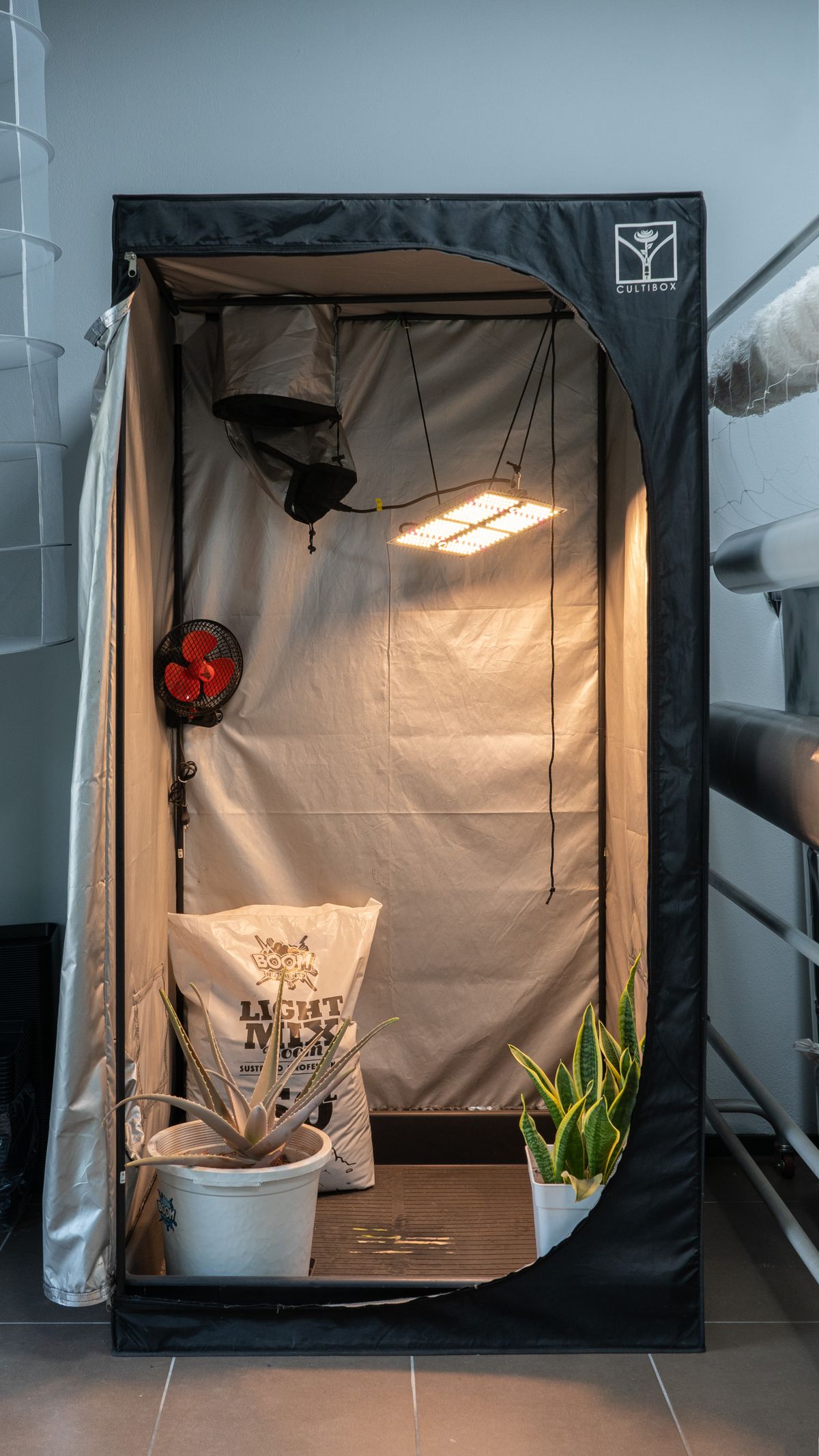
Two plants, 2×4, coco, 280W. Your binding constraint is light — everything else in this guide is about not wasting the photons you have.
At a glance
The one number that shapes this whole grow
Flowering cannabis yield rises linearly with light all the way to 1800 PPFD, measured at ambient CO2 with no enrichment. Your fixture tops out near 1040. That is roughly 58% of the tested ceiling, and reaching 1800 in this footprint would take a 475–500W fixture.
That is not a criticism of the gear — it is the single most useful fact you own. It means when something goes wrong, light is the first thing to check and the last thing to reduce. It means CO2 is pointless for you (you are not light-saturated, so there is nothing for extra CO2 to unlock). It means defoliation to “improve penetration” costs you source leaves you cannot spare. And it means your realistic yield is 70–110 g for a first run, not the 1–2 g/W the internet quotes.
What coco actually is
Coco is soilless, not soil — effectively a simple hydroponic system you run like soil. It carries zero nutrition, so you feed every watering from the seedling stage onward. And it is an ion exchanger: it preferentially binds calcium and magnesium while releasing potassium and sodium, which is why cal-mag is not optional and why runoff pH tells you about the substrate rather than the root zone.
Your full rig — the original setup notes
In the tent today
Everything you actually own, grouped by what it does.
📦The box
- CLOUDLAB 642 tent (2×4×6.5)kit order #603367 — everything big came inside it
- Puroma combo locks ×2through the zipper pulls — this is what makes the tent MD-legal
💡Light & air
- EVO3 280W LEDon the AI+ — click 4, 14″ above the pot top, 550 PPFD
- CLOUDLINE A6 + carbon filterfilter external on top; exhaust and odour — recirculated back into the room
- CLOUDRAY S6 clip fans ×2both level 4 — bottom-left blows under the pots, top-right over them. No airflow, no leaf cooling. Aim before speed: gentle leaf motion, never past soft flutter
- CLOUDFORGE T5 humidifier, 9L800 mL/hr, cool and warm mist, UV-C. It is a UIS device — on an AI+ port holding VPD. Unit sits OUTSIDE the tent, hose sloped up through a port; distilled water only. Warm mist is also 330W of heat, which is the only heat source this tent has when the light is off
🥥Root zone
- Coco2 bricks + one 8-qt perlite bag — 75/25 coco:perlite, buffered; no cal-mag soak needed
- 2× 5-gal fabric potsAC-PFP5, 12″×11″
- Pot feet6–8 in a ring + 1 centre, 1″ lift so the fabric bottom can’t sag
- Catch trays ×213×13×6″ — pot sits on its feet inside
- Wicking pads + pot covers12″ circles cut from the capillary roll; covers cut from spare bucket lids, laid loose
💧Water & feed
- 2× 5-gal food-grade bucketsblack lids, two-bucket rotation — mix fresh, swap, scrub the other
- Air pump + air stonespump outside the bucket, stones in, running 24/7
- UIS Amphibious pump, 528 GPHWPX3 — submerged, Cycle mode: 9 sec every hour, 24 shots/day
- Drip line¾″ line → inline strainer → tee → 2 legs → ¼″ valves → a Plantmate halo on the pad in each pot
- Anti-siphon pinhole1/8″ at the tube’s high point — free, and it stops back-siphoning
- Athena Blended, full lineGrow/Bloom A+B, PK, CaMg, Cleanse, Balance — all in the kit
- GH pH Control KitUp, Down and test dye
- Syringes ×20 + 1000 ml pitcherone labelled syringe per bottle, never share barrels
🎛️Brains & safety
- Controller AI+runs light, fan and pump; reads temp, humidity and VPD; can trigger devices off VPD directly
- AI Hydro Sensorlive reservoir pH, EC and temp
- ELEGRP GFCI adapterauto-reset version — survives a power blip, stays off on a real fault. Wet gear only
- Aqara water leak sensoron the floor beside the trays, not in them — hub siren + phone push
- IR thermometer gunhow leaf temperature actually gets measured. Nothing in the tent senses the leaf — this is the only instrument that does
🌱Seeds
- Lime Coladarun 1 — BOTH plants. Card below
- Pineapple Lushnext run — 9–10 wk, taller, med-heavy
- Papaya Miragerun 2 — the stretchiest, 9–10 wk
Run 1 strain — Lime Colada (MOSI Exotix, feminized)
✂️Harvest & cure
- SCROG net, snips, loupein the kit — iPhone macro does the trichome check
- Harvest Right freeze dryerPharma firmware, shelf 45–55°F — never the 125°F food setting
Coming — and what earns it
Nothing here is bought on speculation. Each one leaves your pocket only when its trigger fires.
Maryland limit: 2 plants, tent locked. One strain per run so you can learn and compare.
🌡️Temp, humidity & VPDWhat to hold at every stage — and what’s dangerous.›
Set the temperature first, then move humidity until VPD lands. Temperature is the lever; RH is the follower.
At a glance
↑ Open the VPD chart & calculator — pinned at the top of this page.
What VPD actually is
Tap any line to open it.
Saturation vapour pressure is what the air could hold
Actual vapour pressure is what it does hold. VPD is the gap — the evaporative pull on the leaf, and therefore how hard the plant is drinking. VPD = es(leaf temp) − es(air temp) × RH/100, where es = 0.6108 × e^(17.27T/(T+237.3)) in Celsius.
Why not just use humidity?
60% RH at 68°F is about 0.75 kPa. The same 60% RH at 82°F is about 1.5 kPa — double the pull, identical number on the hygrometer. RH is a ratio. VPD is a force.
The leaf-temperature question, measured
Bugbee’s lab found well-watered leaves sit within 3.6°F of air temperature under every light source tested, and run about 2°F cooler under LED than HPS. But under water stress with poor airflow, leaves climbed 14°F above air. So the offset is not a constant — it collapses to zero the moment stomata close or the fan stops. So do not adopt anyone’s number — leave the offset at 0 and measure your own with an infrared thermometer. Vendors publish offsets from −2 to −6°F; that spread is itself proof nobody has settled it.
Too low
and transpiration stalls. That matters more than it sounds: calcium moves only in the transpiration stream and can’t be relocated once deposited, so low VPD shows up as tip-burned, hooked new growth. Guttation and fungal pressure follow. Too high and stomata slam shut — CO2 stops entering, photosynthesis flatlines under full light, then wilting and taco-ing.
There is essentially one controlled humidity study on cannabis
It compared low RH (37–58%) against high RH (78–98%) and found high humidity cost 71% of flower biomass, cut CBD-A by 20.5%, and delayed flowering by three weeks. That proves very low VPD is genuinely bad. It does not validate 1.2 versus 1.4 kPa in mid-flower — nobody has run that experiment.
Every stage-by-stage kPa chart you have ever seen, including the one above, descends from greenhouse tomato and ornamental work from the 1980s
Treat the table as a safe operating envelope, not a precision target. Chasing two decimal places is optimising a number nobody has measured for this plant.
What your own tent settled — run 1, Aug 2026
Your readings, not somebody’s paper. Tap any line to open it.
★ You do not have a leaf offset yet — and that is the correct state
The Controller AI+ is at 0, which means it computes VPD as if the leaf were exactly air temperature. That is an assumption, but it is an honest one, and it is the same assumption this whole page is now built on.
A spot reading is not an offset. A leaf that measures 3°F under air at midday and above air an hour later has not given you a setting — it has told you something in the tent changed. An offset is a gap that repeats: same point in the light cycle, several days running, same number. Until then, 0.
★ The leaf–air gap is a live readout, not just a number to type in
Leaf temperature is an energy balance. Light lands on the leaf; transpiration and moving air carry heat away. When the plant is drinking freely and air is crossing the canopy, the leaf sits below air. When it cannot keep up, the gap shrinks and then flips.
Use it as a guardrail while raising temperature. Go up 1°F and read the gap. Gap widens → the plant is transpiring harder and keeping up, go again. Gap shrinks or flips positive → you have found its ceiling for that humidity and that root system. Back off one degree.
Opening the tent door and watching the leaf drop below air within seconds is not a trick of the thermometer. It is the boundary layer being stripped and the vapour gradient opening at once — proof the plant can transpire, and that what is stopping it is the still, saturated air sitting on the leaf.
Airflow — aim before speed
A clip fan mounted high and pointed horizontally passes over the heads of young plants. Turning it from level 4 to level 5 just makes faster wind above the canopy while the leaves keep sitting in dead air.
The test needs no instrument: look at the leaves. Gentle continuous movement means air is reaching them. Dead still means it is not, whatever the level says. Move the fan to canopy height and raise it as the plants stretch. Never past a soft flutter on seedlings.
Raising temperature without adding water pushes VPD up fast
Warm air holds more water, so heating the tent with no humidifier running drops the humidity number on its own — and drags VPD up with it. Starting from 77°F / 60% RH (table assumes leaf 3°F under air; your AI+ at offset 0 reads ~0.3 higher — 1.27 at 77/60):
| Air temp | RH falls to | VPD becomes |
|---|---|---|
| 77°F | 60% | 0.97 |
| 79°F | 56% | 1.16 |
| 81°F | 53% | 1.37 |
| 83°F | 49% | 1.60 |
1.60 kPa is late-flower territory. Hold the humidity and the same climb stays inside the veg band the whole way — 0.97 at 77°F up to 1.18 at 83°F. The degrees are not the problem; arriving without the water is.
Which also answers the “how do I get below 55% RH” question in the other direction: you do not need a dehumidifier for that. Heat alone takes 60% at 77°F down to about 49% at 83°F. The dehumidifier earns its money in flower, when the plants themselves are pushing humidity up.
You already own what the temperature ramp needs
The CLOUDFORGE T5 is a UIS device. Put it on a Controller AI+ port, run the AI+ in VPD mode, and raise the temperature setpoint a degree at a time — the humidifier adds water on its own to hold the VPD you asked for. One number to watch instead of two that argue.
Capacity is not the constraint: 800 mL/hr output against roughly 250–370 mL/hr needed to hold 60% at 83°F. It is the exhaust fan speed that drains the 9L tank, not the humidifier setting — expect a refill every day or two. Distilled only (tap = white mineral dust). Unit outside the tent, hose through a port, sloped up the whole run, no U-bends, aimed into a CloudRay’s breeze.
What the Aug 2026 research pass settled
Four literature searches, ~370 sources.
★ There is a peer-reviewed stage table for cannabis — exactly one
Punja et al. 2024, Plants 13(6):786 (Simon Fraser). It is the only stage-specific RH guidance for indoor cannabis in the literature, and it is more permissive than most grower charts:
| Stage | Temp | RH | VPD |
|---|---|---|---|
| Seedling / cloning | 68–75°F | above 90% | — |
| Vegetative | 77–82°F | 65–75% | 0.94–1.1 |
| Flowering | 73–82°F | 50–70% | 1.13–1.4 |
Note the seedling row wants humidity higher, not lower.
★ The damage threshold is 85% RH — and 70% is the healthy control in the papers that found the damage
Torre et al. 2003 state it directly: stomatal development should happen below 85% RH. Fanourakis’ 2020 review uses RH ≥ 85% as the working definition of “high.”
Here is the part that settles most arguments: in the studies that established high-humidity damage, 60–70% RH was the healthy control arm (Torre used 70%; Fanourakis used 60% = 0.99 kPa). Above 85% you get malfunctioning stomata that can no longer close — and in expanded leaves that is permanent. Below it, nothing.
★★ More drinking is NOT more growing — the correction that matters most
The intuition is that raising VPD makes her drink more, which brings more feed, which grows more plant. The first link is true. The last one is false, and it has been tested directly.
Tomato seedlings taken from 0.9 to 2.2 kPa transpired more and took up measurably more calcium and potassium — and their growth was statistically identical (Ding et al. 2022). The cannabis fertigation mass-balance study found the same: nutrient uptake ran above published sufficiency ranges with no yield improvement.
And at constant temperature, light and internal CO2, net assimilation falls linearly as VPD rises (Bunce 1984). Transpiration is the toll, not the cargo.
A plant only speeds up when you relieve what is actually limiting it. In a well-fed coco system, nutrients are not the bottleneck — the tank is already full, and pumping harder does not fill it more.
Inside 0.2–1.0 kPa, moving VPD does essentially nothing to growth
Grange & Hand 1987, verbatim: “neither growth nor development was affected by humidity below about 90% RH (i.e. a VPD of 0.2 kPa or more) and above about 55% RH (a VPD of 1.0 kPa).”
Every modern constant-temperature study found more biomass at the lower VPD, not the higher — lettuce at 0.7 vs 1.7 kPa, lettuce at 0.78 vs 1.40, and ten species across 60/75/90% RH where dry weight rose 17–68% at 90% vs 60% in six of them.
The smallest VPD contrast anyone has published is about 0.76 kPa. Well-watered ryegrass at 0.59 vs 1.17 kPa showed no difference at all in daily leaf elongation. A five-point RH tweak is below the resolution of the science.
Stability beats the setpoint
Two lettuce treatments with identical mean VPD but different swing — one cycling 0.86–1.32 kPa, the other 0.63–1.63 — differed by 15% dry weight and 29% leaf area (Inoue et al. 2021). If you chase a setpoint with a dehumidifier that cycles hard, the swing costs you more than the mean gains.
Airflow beats dehumidification — with numbers
Punja’s lab measured RH inside inflorescences running 15 points higher and 4.5°F warmer than the room. That microclimate is what bud rot actually lives in, and ambient dehumidification barely reaches it.
Canopy fans cut the RH inside the tissue by 11.6 points and reduced bud rot 81%. Target 0.5–1.0 m/s — a gentle rustle. Unlike dehumidifying, it costs nothing in growth.
Two things everyone repeats that the literature does not support
“Above 80°F you lose terpenes.” Unsupported and contradicted. Holweg et al. 2025 grew cannabis at 88°F day / 81°F night and found high temperature “had no effects on terpenoids.” Four searches for a cultivation-temperature terpene study returned only vendor blogs. The claim confuses terpene boiling points (myrcene 331°F) with growing temperature. Real measured terpene loss happens at drying temperatures of 140°F and up.
“Roots grow at night.” Refuted as an endogenous rhythm. Hold conditions constant across five species and “no change in diel root growth pattern was found” (Poiré et al. 2012). Roots grow when the root zone is warm — outdoors that happens to be night. Indoors it is an argument for warming the reservoir, not the night air.
The root zone is the lever nobody pulls
Raising root-zone temperature +5°F gave +14 to +31% shoot dry mass and +19 to +30% root dry mass at every air temperature tested, with the biggest gains at cool-to-moderate air (Hayashi et al. 2024). Uptake optima elsewhere: cucumber 82°F, tomato 80°F, lettuce 77°F. Below 59°F root hydraulic conductivity collapses.
The standard 65–68°F reservoir rule sits below every measured optimum — it exists for dissolved oxygen and Pythium, which become real above about 75°F. There is no peer-reviewed cannabis root-zone study at all, so this is a genuine tradeoff and a real bet, not a free win.
What the cannabis literature still does not contain
Named honestly so you know where the floor ends: no vegetative-stage temperature experiment · no seedling temperature × vigour study · no root-zone temperature study · no growth-rate vs temperature data · no temperature × nutrient uptake experiment · no veg-stage DIF study · no published survey of what commercial rooms actually run. Every veg/flower setpoint chart online is trade press with nothing behind it.
The lights-off humidity spike (after the 12/12 flip — veg is 24/0)
The water in the air barely changes when the light goes off, but the air’s capacity to hold it drops fast — so RH climbs
Rule of thumb: about 2 points of RH per 1°F of temperature drop. A 10°F drop takes 55% to roughly 75%.
The counter-intuitive fix: run the exhaust FASTER at lights-off, not slower
Most growers do the opposite. Also water only at lights-on, never within two hours of dark, and ramp the fan up 30 minutes before the light cuts.
The one rule that answers most of them
Damage that is worst on the tops, directly under the fixture, and fine six inches away — that is light. Damage that starts at the bottom and climbs, or appears only on new growth regardless of where it sits — that is nutrition. Get this reflex and you will diagnose faster than most people with ten years in.
Am I feeding enough?
Don’t judge this on the leaves first. Judge it on runoff EC against inflow EC
That comparison tells you what is happening before the plant shows a symptom, and it is the single measurement most growers never learn to read.
| Runoff LOWER than inflow | The plant is stripping nutrients out faster than you supply them. This is underfeeding. Raise inflow EC. |
| Runoff ≈ inflow | Eating what you give. Balanced. Hold. |
| Runoff more than +300 µS above inflow | Accumulating in the medium — you are feeding more than it can use. Same strength, bigger pours to 20% runoff until it comes down. |
Two things that will trip you up
Coco holds nothing in reserve, so you feed every watering — a schedule that works in soil starves a plant in coco. And in late flower the fade is intended: bottom-up yellowing at week 6 is the plant doing exactly what it should. The same symptom means opposite things depending on the week.
The honest integrator is growth rate
If nodes are stacking and each leaf set is bigger than the last, it is fed. If growth has flattened and nothing looks obviously wrong, it is usually hungry.
Am I giving too much light?
Probably not — and with a 280W fixture in a 2×4, almost certainly not
This is where the folklore sits furthest from the data. Flowering cannabis yield rose linearly to 1800 PPFD at ambient CO2, no plateau, no damage — and that is where the researchers stopped, not where the plant did. Your fixture maxes near 1040. An established plant under it essentially cannot be over-lit.
And bleaching needs red
Under a balanced white spectrum, cannabis does not bleach below about 2,500 PPFD; inducing it at 800 takes roughly 60–65% red. The EVO3 is 807 white diodes against 27 red. Photobleaching is not a realistic failure mode here.
The errors are not symmetric
Stretch happens in 24–72 hours and never reverses. Over-light is slow and recoverable. Erring bright is safer than erring dim.
Three things constantly mistaken for too much light
Heat and VPD — most “light burn” is leaf temperature and transpiration demand. Water transport — a seedling’s roots cannot supply the transpiration intense light demands; that is a plumbing limit, not a photochemical one, and it is the real reason seedlings want less. Tacoing — upward margin curl gets blamed on light universally and has no peer-reviewed basis as a light signal at all; it is a heat and humidity response.
The leaf-temperature check
A well-watered, transpiring leaf runs cooler than the air around it — measured, within about 3.6°F of air under every light source tested. When a leaf goes warmer than air, evaporative cooling has failed. Under water stress with poor airflow, leaves have been measured 14°F above air temperature. It is not a subtle signal, and it shows up before any visible damage.
But the fix forks, and picking the wrong branch makes it worse
A hot leaf means the plant is not moving water — and that happens at both ends of the VPD range.
So: read the leaf temperature, then read the VPD number, and let the VPD tell you which direction to move.
Two causes that are not heat or humidity at all
Airflow — a still leaf sits in its own boundary layer, a film of saturated air trapping both heat and water vapour. The tent can be perfect and the leaf still cooks. Often the cheapest fix in the room. The roots — a hot leaf over a wet pot is a plumbing problem, not an air problem: waterlogged coco means anaerobic roots, and roots that cannot breathe cannot take up water, so the plant cannot transpire even in ideal conditions.
Do this
- Set temperature first, then chase VPD with humidity.
- Measure leaf temperature with an IR gun.
- Leave the AI+ leaf offset at 0 until you have measured your own.
- After the 12/12 flip: run the exhaust harder at lights-off, not softer.
- After the flip: water during lights-on only (ON 8 PM–8 AM).
- Keep a clip fan moving leaves gently, always.
- Log tent AND room temp/RH together.
Don’t
- Don’t chase VPD with multiple daily adjustments.
- Don’t quote a VPD chart without knowing its leaf-offset assumption.
- Don’t cold-finish for purple colour.
- Don’t sit below 0.43 kPa
If this happens
| Too hot, over 86°F | Dim the light, raise the fan a level. (Veg is 24/0 — no schedule to shift; flower’s ON 8 PM already runs the coolest hours.) |
| Too cold, under 68°F day | Raise light output, lower fan speed, pull the tent off any cold exterior wall. |
| RH too high in flower | Raise exhaust, dump runoff trays promptly, defoliate interior. Dehumidifier becomes mandatory if lights-off RH still exceeds 65%. |
| RH too low, under 40% | Lower fan speed; raise the T5’s RH target. Exhaust can never dry the tent below the room’s own RH. |
| VPD too high, over 1.6 | Veg: let the T5 raise RH (that is the ramp plan). Flower: lower temperature first. Check leaves for taco-ing. Check leaves for taco-ing. |
| VPD too low | Raise temperature or exhaust. Watch for hooked, tip-burnt new growth — that is the calcium symptom, not a feeding problem. |
| Lights-off swing over 15 points | Flower: ramp the fan up 30 minutes before lights-off, hold through the dark. No shots in the 2 h before lights-off. |
| Condensation on tent walls | A surface is below dew point. Raise night temperature, move air against the walls, pull the tent off the cold wall. |
Sources: Chandra et al. 2008 — cannabis photosynthesis vs temperature · Nelson & Bugbee 2015 — leaf temperature vs air by light source · Park et al. 2025 — the one controlled cannabis humidity study · Bok et al. 2023 — day/night temperature differential in hemp · Kim et al. 2025 — temperature vs yield, CBD and anthocyanin · AC Infinity — Controller AI+ VPD mode
💡Light — intensity, height & DLIThe fixture is your ceiling, not the plant. Measured, not guessed.›
Your EVO3 puts out 879 µmol/s. The plant can use far more than that. You cannot over-light this tent — you can only over-heat it. So light is the one lever to push hard, and heat is what tells you when to stop.
At a glance
Why more light keeps paying
The definitive study is Rodriguez-Morrison, Llewellyn & Zheng (2021), University of Guelph, in Frontiers in Plant Science. They ran cannabis through flower at canopy PPFDs from 120 all the way to 1,800 and yield rose linearly the whole way — 116 to 519 g/m², 4.5× — with no plateau at the top. Two details matter:
First, this was at ambient CO₂ (437 ppm). No enrichment. The common advice that “1,000 PPFD is your ceiling without CO₂” is not what the research shows.
Second, THC percentage did not change. Potency was flat across every light level. But because yield quadrupled, total cannabinoids per square metre rose 4.5×. More light means more weed at the same strength — not stronger weed.
The subtlety people miss: individual leaves saturate somewhere around 500–900 PPFD, but the canopy doesn’t. Once the top leaves are maxed, extra photons punch deeper and light up the mid and lower bud sites that were sitting in shade. That is why whole-plant yield keeps climbing long after leaf-level photosynthesis has flatlined.
Your fixture vs the plant
| Where the plant stops responding | not found below 1,800 PPFD |
| What the EVO3 can deliver | ~1,000–1,050 PPFD average at click 10 |
| Stage targets | seedling 200–300 · early veg 400–525 · late veg 630–735 · stretch ~840 · flower 945–1,050 · ripen 735–840 |
You top out at roughly 55–60% of the plant’s demonstrated ceiling. Running click 10 in peak flower is not aggressive — it is simply everything the fixture has, and she would still take more. So the real question is never “is this too much light”; it is “what stops me running click 10”, and the answer is heat, then water, then CO₂.
How to actually measure it
The free Photone app turns your phone into a usable quantum meter — within about 10% of a real one, which is plenty.
Lay one sheet of plain white printer paper over the front camera as a diffuser. Skipping that is the single biggest source of bad readings. Set the source to LED. Put the phone screen-up at the top of the canopy, dead centre, then take a second reading at each corner. The corner-to-centre spread tells you whether to raise the fixture.
Re-measure weekly. Height is measured to the top leaf, so the gap closes as she grows and your PPFD drifts upward on its own.
Three ways to read this wrong
Bleached white tips means dim the light
No. Bleaching is a distance problem — the top two inches are too close to the diodes. Dimming costs you intensity across the entire canopy to fix a problem that exists in one small zone. Raise the fixture 3–4″ instead. Same total photons, better spread, bleaching stops.
The dial is the main control
Height moves the number harder than the dial does at seedling heights, and it moves uniformity too. In this tent, going from level 6 @ 35″ to level 7 @ 24″ was worth about a third more light — height did most of it. Set height first, then trim with the dial.
The box number is the canopy number
“1,745 PPFD” on the EVO3 listing would require 6.2 µmol/J of efficacy. The physical ceiling for an ideal LED is about 4.6. It is a centre-point reading taken close to the fixture. The honest figure is 879 µmol/s of total output, and what reaches your canopy depends entirely on height.
Sources
Rodriguez-Morrison, Llewellyn & Zheng 2021, Frontiers in Plant Science 12:646020 · AC Infinity IONFRAME EVO3 product specification · Photone readings taken in this tent, Aug 3 2026.
🌱Day 0 — start the seed · 1–5 daysStraight into its final pot. Never touch the root.›
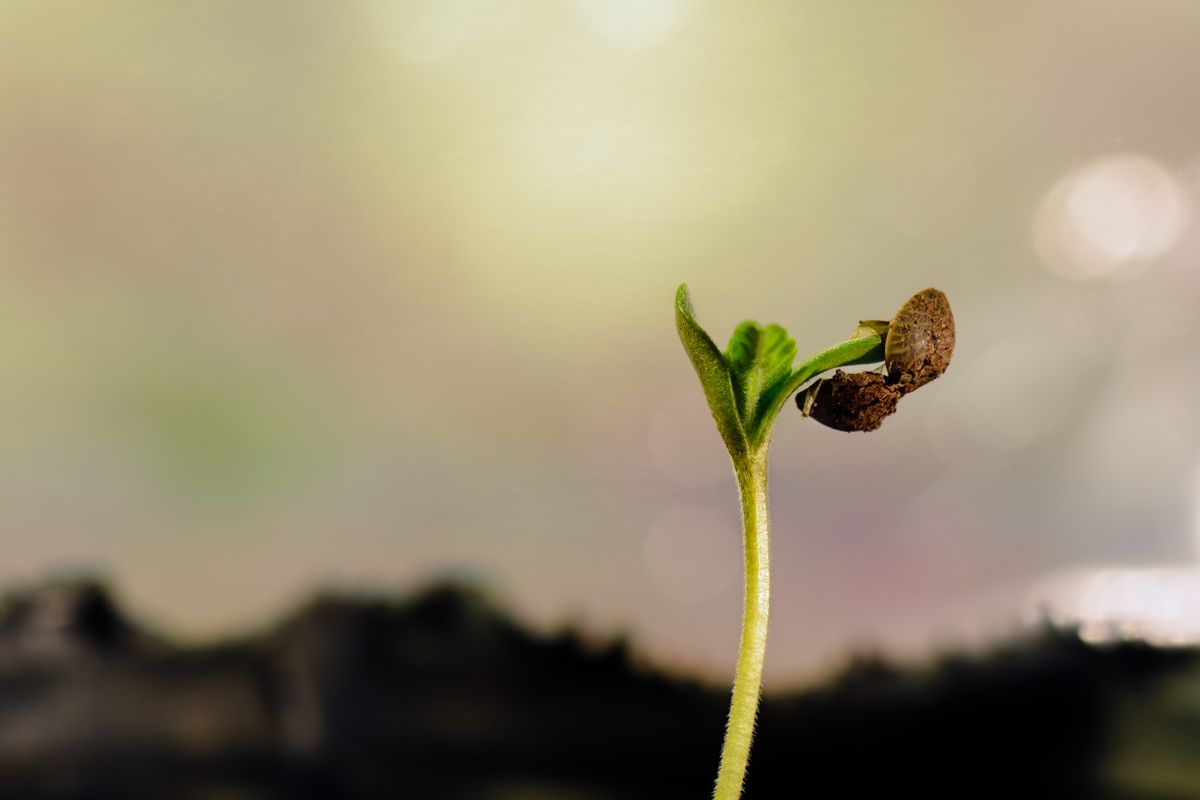
Sow ½″ deep, pointy end down, straight into the final pot. Wet the coco first, keep the top inch damp — then leave it alone for 3 days.
At a glance
Do this
- Pre-soak the coco.
- Squeeze-test it.
- Sow ½″ deep, pointy end down.
- Two seeds, both Lime Colada.
- Set the tent to 75–82°F and 70–85% RH.
- Light on click 1, 24/0, from day one.
- Set inflow pH to 6.1–6.3 and leave it there.
- Mark the sow date on the pot.
- At emergence: step to click 2.
- At first true leaves: hold 200–300 PPFD.
Don’t
- Don’t soak past 24 hours.
- Don’t water the whole pot again.
- Don’t point a fan at it.
- Don’t dig it up to check.
If this happens
| Nothing by day 7 | Normal. Direct-sowing runs 5–10 days and has a lower success rate than a paper towel — that’s the trade you made for never touching the root. |
| Nothing by day 14 | Call it and sow a replacement. 14 days is the industry viability window. |
| Shell stuck on the leaves | “Helmet head.” Wait 24–48 h — most shed on their own. Then mist the shell through the day to soften it. Only then: pointy tweezers, closed narrow, into the crack where the root came out, and let them open to pry. Hold the stem. Zero force. |
| Long pale stem, leaves riding high | Stretching — not enough light. Raise one click. It happens in 24–72 h and never reverses, so judge new growth in 3–4 days, not the stretched section. |
| Stem pinches and darkens at the coco line | Damping off. That one is gone. Raise airflow and light. Don’t reuse the pot without a 10% bleach soak. |
| Emerged, then stalled | Almost always waterlogged roots in an oversized pot. Aerate the coco with a chopstick away from the stem, check the drain holes aren’t blocked. |
| Leaf edges curling up | “Tacoing.” Check temp and VPD before touching the dimmer. At click 2–3 this is heat, not light — the EVO3 is 807 white diodes against 27 red, nowhere near the red-dominant spectrum that actually bleaches. |
→ Full diagnostics: is it feeding, light, or environment?
Why this works — the full explanation
Sow it direct. Plant the seed ½″ deep, pointy end down, straight into its final coco pot. Cover lightly. That pot is its home for the whole grow: no plugs, no transplant, ever.
Why direct beats a paper towel: the taproot is never touched, never sees light or air, never knits into paper fibres and never gets planted bent. Handling a taproot is the most common way a seed that was going to be fine ends up dead.
The soak — optional, and here’s what it actually does
Germination doesn’t start with growth, it starts with drinking. A dry seed is about 5–10% moisture and asleep. Taking on water swells the tissue and splits the shell (that’s how the root gets out), switches on the enzymes that unlock the food stored inside, and ends dormancy. Soaking just front-loads that — faster and more evenly than waiting for patchy contact with damp coco. It also softens an old or hard shell.
So: 12–18 hours in plain water, and never past 24. The embryo is breathing in there and water pushes the air out — past a day it starts to suffocate. Longer is not safer here, same as with the taproot.
Ignore whether it floats. Floating is about weight, shape and trapped air, not whether anything alive is inside — side-by-side trials have floaters and sinkers germinating at nearly the same rate. Sinking is a rough timer, not a viability test, and a floater is not a dud.
Light on while it’s underground?
Yes — run it at click 1 from day one, on whatever photoperiod you have chosen (yours is 24/0). Not for the seed, which is under half an inch of coco and doesn’t care about light. Do it so the tent is already at target and already in rhythm when the shoot appears — you don’t want a seedling breaking ground into an environment that’s still settling. Click 1 also adds a touch of warmth, which is exactly the right amount to add this way.
Don’t crank it high to warm the tent. Strong light dries the top half inch — exactly where the seed sits and exactly where the shoot has to get out — and warming the air drops your humidity reading at the same time. If you ever do need real root-zone warmth on a cold run, heat from below with a thermostat mat, never from above with the lamp.
Run 1: Lime Colada ×2 — 8–9 weeks, the most forgiving of the three. One strain per run: Pineapple Lush next, Papaya Mirage after.
18/6 vs 24/0 — the honest version
The case against 24/0 is much weaker than the forums claim. There is exactly one dedicated cannabis study (Šrajer Gajdošik 2022): two industrial hemp cultivars at ~250 PPFD, 16/8 vs 20/4 vs 24/0, measured at 5 weeks. It found rising lipid peroxidation and falling photosynthetic performance under longer photoperiods, and concluded 16/8 was best. But it measured biochemical stress markers only — no biomass, no growth rate, no yield. Meanwhile a published hemp speed-breeding protocol runs two weeks of 24/0 at ~500 PPFD with no injury reported. That is the entire cannabis evidence base.
Three things growers say about 24/0 that are simply not true. “Plants need darkness to repair” — the PSII repair cycle and D1 protein turnover are light-driven; darkness stops new damage but does not enable repair. “24/0 causes hermies” — the documented light trigger runs the opposite direction: short photoperiods (8–11 h) produced male flowers in 25–45% of female plants, and a controlled test of dark-period light leaks found no effect at all. “Roots grow at night” — never measured in cannabis, and under continuous light total root biomass generally rises because more carbon is available.
And at fixed daily light, continuous light usually wins. Lettuce at matched DLI: +23% fresh and dry weight, light-use efficiency up 7–11%. Rocket at matched DLI: +45% biomass. Tomato: higher dry matter from continuous carbon gain with no overnight respiration debt. Cannabis has never been classified as continuous-light tolerant or sensitive — it is on neither list.
So what IS the real risk? Daily light integral, not the clock. The definitive lettuce work put it plainly: photooxidative stress under continuous light “can be attributed to excessive daily light integral instead of circadian asynchrony.” Do the arithmetic for this tent. Click 3 on 24/0 = 22–27 mol/day. The seedling window is 15–20. That is a mid-veg light dose on a plant that has just cracked the surface. Click 2 on 24/0 = 15–18 mol — right where it should be.
If you run 24/0Stay on click 2 for the first 10–14 days, not click 3. You already get the extra hours — you don’t need the extra intensity stacked on top. Then consider a temperature swing. Under 24/0 there is no lights-off, so your tent never cools — and constant temperature under continuous light is the specific condition that caused injury in tomato, potato, eggplant, sweet pepper, cucumber, rose and bean across studies running from 1931 to 2017. A daily drop prevented it in every one. A swing of just 7°F is enough to reset a plant’s internal clock; the classic prescription is 14–18°F for a couple of hours. Honest limits: nobody has ever tested this on cannabis, and a 2×4 tent can’t get colder than the room it’s in — without an AC you can only reach a few degrees by running the exhaust hard. Do it from the room thermostat if you want a real one, and watch your humidity: a 20°F drop roughly doubles RH, which is bud rot territory later in the grow.
One thing 24/0 genuinely does better: it kills the lights-off humidity spike. Under 18/6, temperature drops at lights-off while absolute humidity holds, so RH jumps and VPD collapses — a real problem in a small apartment tent. 24/0 holds temperature, RH and VPD flat. The catch is that this same thermal constancy is exactly what the injury literature blames, which is why the temperature swing above matters.
What mol/m²/day actually means — and is it per hour or per day?
The units first. Photosynthesis counts photons, not energy — a chlorophyll molecule absorbs one photon and moves one electron whether that photon is blue or red. Photons are counted in moles, the same way chemists count molecules: one mole = 6.022×10²³. PPFD (µmol/m²/s) is a rate — photons landing on a square metre each second, the light equivalent of speed. DLI (mol/m²/day) is a quantity — the day’s total, the equivalent of distance travelled. DLI = PPFD × hours × 3600 × 0.000001. At 400 PPFD for 18 hours that is 25.9 mol — about 1.6×10²⁵ photons per square metre, enough to cap the day’s gross sugar production near 65–78 g/m².
Now the real question: is the plant limited by a rate, or by a daily budget? The answer is both, through two different mechanisms, and they separate cleanly.
Damage is a dose. When researchers blocked a leaf’s repair machinery and hit it with everything from 6.5 to 1500 PPFD, the odds that any given photon damaged a photosystem stayed constant across that entire 230-fold range. A later study extended it to five orders of magnitude using microsecond flashes and got the same answer. So total damage tracks total photons — that part is genuinely per-day.
But every defence is a rate. Non-photochemical quenching takes minutes to engage. D1 protein repair runs at a fixed maximum speed. Antioxidants clear at a finite rate. Sugar export from the leaf has a ceiling. So what you actually see is damage inflicted (dose) minus damage repaired (rate). Deliver the same daily total faster than repair can keep up and it accumulates; deliver it slowly and the plant never falls behind.
Which is why spreading light over more hours wins. At 189 PPFD, 67% of absorbed photons do useful photochemistry. At 794 PPFD, only 28% do — the rest is dumped as heat or worse. Every controlled experiment that held daily total constant and varied intensity against duration found longer-and-dimmer equal or better: lettuce +16%, mizuna +19%, Rudbeckia +30% shoot dry matter, lettuce +96% at the warmest temperature tested. That asymmetry runs in one direction, and it is the strongest argument in favour of a long photoperiod at moderate intensity.
A correction to what this guide said before. The lettuce study everyone cites — the one concluding stress comes from “excessive daily light integral instead of circadian asynchrony” — ran all three of its treatments at 24 hours. Intensity and daily total moved together perfectly, so that study cannot separate the two. It validly rules out the circadian explanation. It does not prove daily total matters more than intensity. That was over-read here and it has been fixed.
And the charts don’t even agree with themselves. “Seedling: 100–300 PPFD, DLI 15–20” is arithmetically impossible at the bottom end — 100 PPFD cannot reach DLI 15 at any photoperiod, since 24 full hours only gets you to 8.6. The two columns were assembled independently and never checked against each other. Neither is a measured cannabis number: no published study has ever established a light dose-response for cannabis seedlings. Pick the DLI target, pick the photoperiod, then compute the PPFD. Never read them off the same row.
For context on the ceiling: flowering cannabis yield rose linearly all the way to 1800 PPFD with no damage and no CO2 enrichment — and that was where the researchers stopped, not where the plant did. Individual leaves saturate near 1500, but a canopy doesn’t, because raising the light pushes photons deeper into the lower leaves. Nothing here is close to a limit for an established plant. A seedling’s real constraint isn’t photon toxicity at all — it’s a root system too small to supply the water that intense light demands.
The pH schedule — and the one place it is easy to get wrong
Coco is not inert the way people say. It has real cation exchange capacity and it preferentially grabs calcium and magnesium while releasing potassium and sodium. A seedling has almost no root mass to compete for that calcium, and calcium is immobile — it cannot be moved from old tissue to new. So you run the inflow pH high on purpose, 6.1–6.3, because calcium solubility improves at the top of the range.
The trap is when to dial down. The instinct is “drop the pH once I start feeding” — but feeding starts during the seedling stage, not after it. You begin fertigating at EC 400 once the cotyledons have been open 24 hours, climbing 75–100 points per event toward EC 1000. All of that happens while pH should still be high. Dial down at the veg transition — full seedling strength, true leaves stacking, roots established — not at first feed. Then it is not one step down but a step down and back up: 5.5–6.5 averaging 5.9 through veg and mid-flower, back to 6.1–6.3 at ripen.
Ignore runoff pH. Because coco is an ion exchanger, runoff reflects exchange reactions with the substrate rather than conditions at the root. Chasing it destabilises the root zone. Adjust the inflow, measure the inflow, and let the runoff say whatever it wants.
⚠ One conflict to settle before flower. Athena’s Blended chart specifies 5.5–5.8 for coco in veg — materially lower than the 6.1–6.3 above. Their line is heavily calcium-fortified and buffered, which plausibly removes the reason to run high. Both schedules are internally coherent; blending them is what causes trouble. Pick one and follow it. Also worth knowing: Athena’s pH varies by medium, not by week — the 6.0–6.4 column people quote is the peat column, not a week-7 change. All nine flower weeks share one range.
On the temperature range
The sources genuinely disagree, so here is the honest version. The peer-reviewed cardinal-temperature work puts the highest germination percentage at 66–75°F and the fastest germination at 85°F. The grow references land higher — Coco For Cannabis says 80–86°F, GrowWeedEasy 75–80°F. Warmer is faster, cooler is marginally more reliable. The card above reflects the working range, not the lab optimum.
What happens next
- 30–43 hShell splits, white taproot pushes out. Underground — you won’t see it.
- Day 3–5A pale loop of stem arches up through the surface. Click 1 → 2 now.
- +2 daysCotyledons — the two round seed leaves — open and go green.
- Day 5–10First true serrated leaves. Hold click 2 (24/0).
- Day 10Nothing up yet? Suspicious, not fatal. Hold.
- Day 14Still nothing — dead. Sow a replacement.
- → NextWeeks 1–2 — seedling. First feed at EC 0.4–0.5.
Feed & water nowPre-soak the coco first — plain water at pH 5.5–5.8 until a little runs out the bottom. Coco arrives thirsty and will otherwise pull moisture straight back out of the seed. Damp, not soaked: a swamp at ½″ deep rots the seed before it can crack. Keep just the top inch evenly moist until it breaks ground. After that, Once it breaks ground: pump takes over — 9 sec hourly via halos — never the whole pot.
Sources: Geneve et al., Crops 2022 — cardinal germination temperatures · Šrajer Gajdošik et al. 2022 — photoperiod & lipid peroxidation · Moher et al. 2022 — light intensity & internode length · AC Infinity — germination stage · Coco For Cannabis — seedlings in coco · PNW Handbook — hemp damping-off · Purdue — DLI & transplant quality · Fluence — photobleaching · Zha et al. 2019 — continuous light is a DLI problem, not a clock problem · Temperature swing restores photosynthesis under continuous light · Sysoeva et al. 2010 — which species tolerate continuous light · Hermaphroditism in Cannabis sativa — documented inducers · Coco For Cannabis — pH by stage · Coco For Cannabis — fertigation frequency · UGA B1256 — pH and nutrient availability · Tyystjärvi & Aro 1996 — photodamage is proportional to photon dose · Elkins & van Iersel 2020 — photochemical efficiency falls as intensity rises · Elkins & van Iersel 2020 — equal daily light, longer photoperiod wins · Ikkonen et al. 2015 — a daily temperature drop prevents continuous-light injury · Avello et al. 2019 — a 7°F thermocycle resets the plant clock · Bok et al. 2023 — the only day/night temperature study on hemp · Rodriguez-Morrison et al. 2021 — cannabis yield linear to 1800 PPFD
🌿Weeks 1–2 — seedling · the fragile partTent held humid, pump 9 sec hourly, light click 4 @ 14″.›
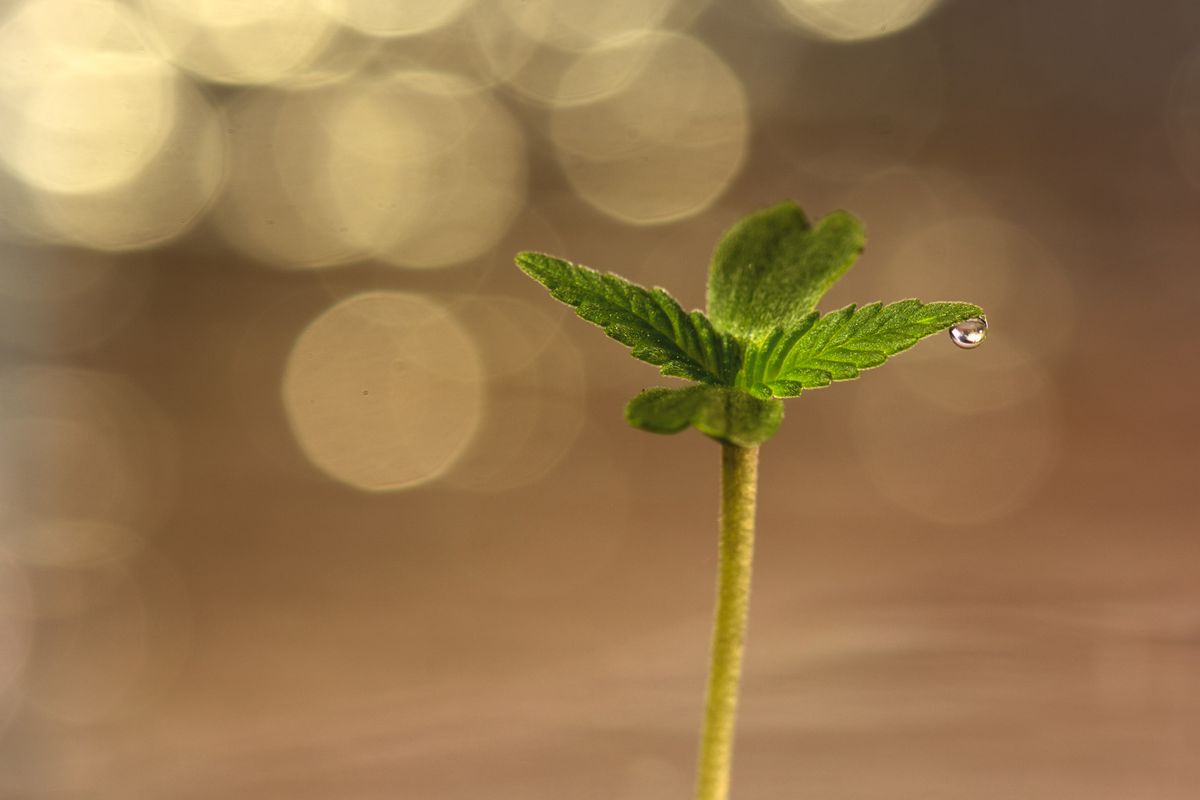
Start feeding 24 hours after the cotyledons open, at EC 400. Ramp 75–100 points every feed. Touch nothing else.
At a glance
Do this
- Start fertigating 24 hours after the cotyledons open, at EC 400.
- Raise inflow EC 75–100 µS every single feed.
- Pump 9 sec hourly via halos.
- Light: click 4 @ 14″ = 550 PPFD.
- 2× S6 level 4 — one under the pots, one over, horizontal.
- pH the solution LAST, after every part is mixed in.
- Log runoff EC the moment you get runoff.
- Do nothing else.
Don’t
- Don’t jump to Athena’s veg dose.
- Don’t top, train or defoliate.
- Don’t panic about no runoff.
If this happens
| Droopy, soft, whole plant, pot feels heavy | Overwatering. Check drain holes and airflow — don’t dry the pot. |
| Droopy with crisp edges, pot feels light | Underwatering. Increase frequency, not volume per event. |
| Cotyledons yellowing | Normal senescence as the seed reserves empty — provided the true leaves are green. |
| Cotyledons yellow AND first true leaves pale | You started feeding too late. Go to EC 400 immediately and ramp. |
| Burnt tips on the first true leaves | EC too high for the root mass. Flush with pH 6.5 water until runoff EC drops under 100, restart at 400. |
| Long thin stem, leaves reaching | Under 100 PPFD. Step up a click. |
| Stem pinched brown at the coco line, plant flops | Damping-off. Not curable. Remove it, raise airflow, cut watering, and bleach anything reused. |
| No new node in 3–4 days | Root zone under 68°F or waterlogged coco. Check substrate temperature before you change anything else. |
| Pale new growth at the top | Nitrogen or pH. Verify inflow at 6.2–6.4, then step EC up one increment. |
→ Full diagnostics: is it feeding, light, or environment?
What happens next
- Day 5Cotyledons open 24 h. First feed: EC 400, pH 6.2–6.4. Click 1.
- Day 6–7First true leaf pair. EC ~500–600.
- Day 8–10Node 2 forming. EC ~700–850. Click 2. First real runoff usually appears.
- Day 10–12EC reaches ~1000 — full seedling strength.
- Day 12–14Node 3. Click 3. EC moving toward the 1100–1400 early-veg band.
- Advance when3 true nodes, consistent 10–20% runoff, roots reaching the pot wall.
Sources: Coco For Cannabis — seedlings in coco · Coco For Cannabis — EC targets · Coco For Cannabis — topping thresholds · Penn State Extension — damping-off · UC ANR — air movement and photosynthesis
The original seedling notes — dome, fans and the click table
One job: don’t drown it and don’t blast it.
The tent is the dome
Domes exist for clones — a cutting has no roots, so it drinks through its leaves or it dies. Your seedling has a taproot from the moment it cracks and can drink from the coco. It doesn’t need a bubble; it needs the right room. So run the whole tent at seedling humidity — 65–75% RH at 75–80°F, which is the 0.5–0.8 kPa row in the VPD card above — and skip the dome.
Two reasons this beats doming. There’s no removal cliff — nothing acclimatises to 95% and then gets dropped to 55%, which is the wilt people blame on everything else. And a seedling that transpires a little has a reason to build roots looking for water; one sitting in saturated air doesn’t.
Two fans, two different jobs
The clip fans move air inside the tent. The exhaust exchanges it. Only one of those can be skipped now.
Clip fans: on, low, indirect. They earn their place in week 1 — even temperature, no stagnant pocket sitting on wet coco (that’s your damping-off defence), and stem strength: a seedling that never feels moving air grows floppy and needs staking later. Aim them so the leaves barely flutter, never straight at the seedlings.
Exhaust: starve it, don’t kill it. There’s no heat and no smell yet, so two of its three jobs don’t exist — but the third does. Your tent holds roughly 1,100 L of air; at 420 ppm that’s under a gram of CO2 in the whole box. Seedlings won’t strip that in an hour, but over a day in a tight tent they’ll draw it down, and under ~250 ppm photosynthesis stalls. Run it at level 2 minimum — never 0 — VPD mode, Dynamic Transitions ON. Better: low base speed with a humidity trigger on top, so it only steps up when RH climbs past your ceiling — air gets refreshed, humidity doesn’t get stolen.
Your light — what the 10 clicks actually mean
These numbers are now measured, not guessed. On Aug 3 2026 two Photone readings were taken in this tent — click 6 at 35″ = 300 PPFD and click 7 at 24″ = 410 PPFD — and the whole table below is fitted to those Aug 3–4 points. The Aug 9 measured point — click 4 @ 14″ = 550 — beats any fit: trust measured. The earlier version of this table was calculated from the fixture’s rated output and it over-estimated by roughly 35% at long hang heights. Falloff with height in a reflective tent is far gentler than inverse-square: a bar light at 2–3 ft is a near-field source, not a point source.
| Stage | Click | Height | PPFD | DLI |
|---|---|---|---|---|
| Seedling wk 1–2 | 3 | 26″ | ~170 | 15 24/0 |
| Early veg wk 3–4 | 5–7 | 24″ | 290–410 | 25–35 24/0 |
| Late veg wk 5 → flip | 8–9 | 18–20″ | 505–595 | 44–51 24/0 |
| Stretch & flower | 10 | 14–16″ | 695–735 | 30–32 12/12 |
| Ripen | 8–9 | 16–18″ | 505–595 | 22–26 12/12 |
Mind the flip cliff. Veg runs 24/0 and flower runs 12/12, so the day you flip you lose half your daily light at the same dial. Going from click 9 in late veg (DLI ~51) to click 10 in flower (DLI ~30) is still a 40% cut. That is normal and unavoidable — but it is why the fixture goes to full power and its lowest safe height the moment you flip, not gradually.
Measure height to the top leaf, not to the pot. As she grows the gap closes on its own — a plant that gains 6″ of height gains roughly 40–50% more light without you touching the dial. Re-check with Photone weekly; the move you make next is usually raising the fixture to hold the number, not turning it up.
Light schedule now: you are running 24/0 (this line originally read 18/6 — updated to match your actual schedule). Raise the light before you dim it — distance is gentler than a dark room. If the seedling reaches and stretches thin, it wants more; if the leaves pray hard and the edges curl, raise it 3–4″ — don’t dim.
Feed & water nowPump 9 sec hourly via halos (24 shots/day). Feed every shot; 10–20% runoff; dump the trays — a full-pot drip would drown roots that haven’t gone looking yet. Coco is inert, so it eats from day one: mix at EC 1500 → 2100, pH 5.8–6.2. Every watering feeds; there is no plain-water week.
How you mix a batch, every time: 10 L of water (the chart is written per 10 L — no conversion), added in this order — Balance → Grow B → Grow A → PK → CaMg → Cleanse. Never pour two concentrates together. Then set pH. One labelled syringe per bottle. This order never changes for the whole grow — only the strength does.
Balance is two things. The chart lists it as pH-up only, but it is potassium silicate (0-0-2, 5% silicon dioxide). Run 13 mL per 10 L in every batch as a silica supplement — stiffer stems, thicker cell walls, more stress tolerance — then bring pH back to 5.8–6.2 with pH Down, added last. Balance goes into the water first, before anything else, never into a concentrate. No loading dose: silicon is laid down as solid silica in the tissue being built that week and, once deposited, is never moved again — so 26 mL once does nothing that 13 mL every time doesn’t. Athena’s label allows 5–26 mL per 10 L as needed; 13 sits mid-range. Stop it, with CaMg, when the trichomes say two weeks out — see the finish.
Training nowNone. Don’t touch it. Anything you do to a seedling costs you more than it gains.
🪴Weeks 3–6 — veg · you decide the lengthRoots take off, the drip takes over, training starts.›

Veg is where you buy your yield — not with nutrients, with canopy area. Top once at 4–5 nodes, net it, and flip at 12–14 inches.
At a glance
Running 24/0
24/0 spreads the dose, but the plan still climbs: 400–525 PPFD early veg → 630–735 late. Step one click or 2–3″ at a time, watch tops 48 h.
The stretch math — do this before you touch anything
Your tent is 72″. Subtract the fixture and hangers (~6″), the light-to-canopy gap you must maintain (18″), and the pot (~12″). That leaves 36″ of plant.
Sativa-leaning genetics multiply 2–3× in height after the flip. At 3×, 36 ÷ 3 = 12″ at flip. At 2.5×, 14″. At 2×, 18″. Lime Colada and Pineapple Lush are both sativa-leaning — plan for 2.5× and flip at 12–14 inches.
That number is your net height. Which is why the screen goes at 8–12″ above the pot: the net physically enforces the ceiling that the arithmetic demands.
Training — what is evidence and what is not
Topping has real data. In field hemp, topping above node 4 cut height 17–21% and raised dry biomass 25–29% against untopped controls. In medicinal cannabis, topping beat lollipopping and control on inflorescence dry weight — though the total cannabinoid yield difference was not statistically significant.
Plant density has real data, and it says something useful: 10 plants/m² at 28 days veg yielded 1009 g/m²; 18 plants/m² at only 10 days veg yielded 1091 g/m². Area yield tracks canopy fill, not per-plant size. With two plants in 8 ft² and a legal cap you can’t exceed, filling the canopy is the entire job.
SCROG versus LST versus untrained has no peer-reviewed comparison at all. Neither does tucking cadence, net height, percentage fill at flip, or “stop training N days before flip.” All of it is grower convention. It is sensible convention, and the density data supports the underlying logic, but nobody has measured it.
Verdict for this tent: top once at 4–5 nodes, then SCROG. The screen controls height better than LST because it is a hard physical ceiling, and height is your binding constraint. Net 8–12″ above the pot, flip when it is 70–80% full.
Do this
- Top once, above node 4–5.
- Install the trellis net around week 2 of veg.
- Feed to 10–20% runoff every single time.
- Measure runoff EC at every feed.
- Start Athena at 1.4–1.6 EC and climb toward 2.1.
- Hold VPD at 0.8–1.0 kPa.
- Stop all training 7–10 days before the flip.
Don’t
- Don’t let the coco surface dry to light brown.
- Don’t run click 8 in veg.
- Don’t chase runoff pH.
- Don’t skip the stretch math.
If this happens
| Crispy tip burn, very dark green leaves | Nutrient burn. Runoff EC is over inflow +300 — salt stacking. Same strength, bigger pours to 20% runoff until it comes down. |
| Necrotic spots on NEW growth | Calcium. Raise VPD toward 1.0, add airflow, verify pH is not above 6.2. Calcium moves in the transpiration stream — if the plant isn’t drinking, it isn’t getting any. |
| Interveinal yellowing on OLDER leaves | Magnesium. Check inflow pH is not below 5.5. |
| Leaves clawing downward, dark and glossy | Nitrogen toxicity. Step inflow EC down 0.3 and confirm against runoff. |
| Multiple deficiencies at once | Almost always pH lockout, not multiple deficiencies. Reset inflow to 5.9, allow drift, feed to 20% runoff. |
| Droop with a heavy wet pot | Not underwatering. Oxygen or EC problem in the root zone. |
| Leaf edges curling up | Heat. Pull to 77–84°F, raise the light or drop a click. |
| Bleaching and very tight node spacing | Light too close. Raise it 3–4″ — don’t dim. |
→ Full diagnostics: is it feeding, light, or environment?
What happens next
- Wk 3 d1–2Top above node 4–5.
- Wk 3 d3–7Recover. Two new apical shoots. Begin bending the mains outward.
- Wk 4Net goes in 8–12″ above the pot. Start weaving. PPFD to ~500.
- Wk 5Net filling. ~600 PPFD. EC at the top of range.
- Wk 6Stop all training. Let wounds close for 7–10 days.
- Flip whenNet 70–80% full, canopy even, height at or under 12–14″, no open wounds.
Sources: Hemp topping trial — height and biomass · Plant density and area yield in cannabis · Llewellyn & Zheng — light intensity and yield · Coco For Cannabis — EC targets · Coco For Cannabis — watering coco · Athena — veg stage
The original veg notes
Growth goes from millimetres to inches a day. This is the stretch of the grow where you decide the final size — the longer you veg, the bigger the plant, and a 2×4 fills up fast. A sensible target is a plant that fills its half of the tent with the net about 70% covered before you flip.
Light climbs with the plant: click 4–5 at 20–24″ early, moving to 6–7 at 18–20″ as it thickens. Still 24/0.
Feed & water nowAround week 3, once roots reach the pot walls, the drip runs: 9 sec every hour (24×/day) to 10–20% runoff. Step the mix up from ¼ chart to full chart across weeks 3–4. Read runoff EC, not the calendar — veg lands around EC 2.1. pH 5.8–6.2 now the plant is bigger. Cleanse in every batch; change the res on EC/pH drift.
Training nowThis is where training lives. Do it in this order, on the plant’s schedule, not the calendar:
1 · Top once, at 4–5 nodes (usually week 3–4). Cut the growing tip just above the node. You trade a week of speed for two main colas instead of one.
2 · LST as it recovers (a few days later). Tie the two new mains outward and down, so the middle opens up. Soft ties, never on a stem you just cut.
3 · Fit the ScrOG net once the plant is ~8″ tall — roughly 6–8″ above the pot rim. From here you stop training upward and start weaving outward.
4 · Tuck, every other day. Any shoot poking above the net gets bent under it and moved into an empty square. Flat canopy, every top at the same height — that’s the whole game.
5 · Clean the bottom third a few days before you flip. Remove the weak shoots and leaves that will never see light. They only cost you energy and hold humidity down where you don’t want it.
Flip when the net is ~70% full — it will roughly double in the two weeks after.
🔀The flip — weeks 1–2 of 12/12 · the stretchLights to 12/12. She doubles. Last hands-on window.›
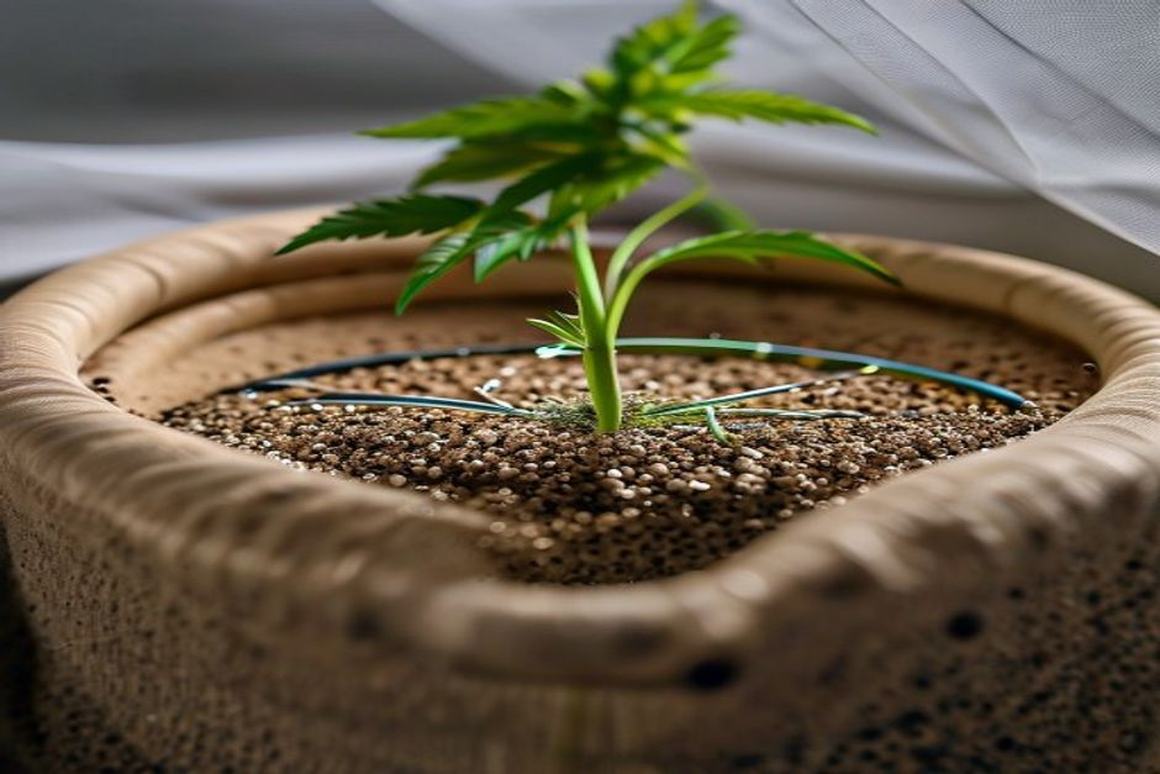
Flip abruptly — 24/0 straight to 12/12, no stepping. Then watch the ceiling: 60–70% of your total stretch lands in the first 14 days.
At a glance
Three photoperiod myths, checked
“Step the light down gradually.” No evidence. Every Guelph photoperiod trial flips abruptly and gets flowering initiation in 8–11 days. Go straight from 24/0 to 12/12.
“A light leak will turn them hermie.” A 2024 study of 403 indoor plants used distance-to-door as a proxy for dark-period light and found it explained 1.6% of the variance in male flower formation — the authors advised growers not to spend resources sealing door leaks. Bugbee’s threshold is that cannabis cannot even perceive light below about five times full moonlight. The real risk from a leak is delayed flowering, not hermaphroditism — measured at roughly 6 days delay at 62 µmol of near-infrared, 12 days at 121.
“12/12 is optimal.” It is convention. Ten cultivars tested across 12 to 15 hours all flowered up to 14 h, and three initiated at 15 h. Peak floral biomass landed at 12.6–13.0 h depending on cultivar, and a follow-up found 13 hours yielded 35–50% more than 12 in two cultivars with THC unchanged or slightly higher. There is no universal critical daylength. If you want to test 13/11, run it on one plant, not both.
The stretch
Starts within 2–4 days of the flip, peaks days 7–14, essentially finished by day 21. What actually controls it, in order of evidence: light intensity (low PPFD produces etiolated stretch — measured, plants under low light were shorter and wider with thinner stems, high-light plants taller with denser flower), far-red (increases height in every genotype tested; your EVO3 has three 730nm diodes, always on, not separately switchable), temperature differential (flattening day/night restrains elongation), and training.
Honest gap: no peer-reviewed stretch multiplier by cultivar type exists. The 2–3× sativa figure is entirely breeder and vendor convention. The Guelph papers report “growth index,” not stretch ratios.
Sex identification — day 8 onward
Pistils (female): two white or cream hairs emerging from a teardrop-shaped calyx, at the nodes and apex. Pollen sacs (male): smooth round-to-oval balls in grape-like clusters, no hairs, on a short stalk. Nanners: elongated yellow or lime hooks protruding from inside a bud, often in bunches — these shed pollen without bursting, which makes them more urgent than an obvious sac.
Feminized seed keeps your risk low but not zero: a study of about 1000 plants across three cultivars found hermaphroditic anthers in 5–10%, appearing in weeks 4–7 of flower. The progeny were 100% female. Your real trigger is cold — exposure near 55°F raised male-flower incidence by roughly 26 percentage points. Hold the dark period at 68–72°F.
Do this
- Flip at 12″ or under if you can.
- Net is already in from veg — tuck every 2–3 days.
- Hold EC 2.1 through the flip; ramp toward 2.4 from day 8.
- Measure PPFD at canopy weekly and raise the light as the plants rise.
- Keep the dark period genuinely dark.
- Hold cal-mag at full veg dose through day 21.
- Log height daily for 21 days.
Don’t
- Don’t step the photoperiod down gradually.
- Don’t defoliate heavily during days 1–14.
- Don’t add bloom boosters before day 14.
- Don’t let the coco dry back.
If this happens
| Under 10″ of headroom left | Supercrop the tallest colas — days 10–16 only, never after day 21. Raise the light to 18″ and drop to click 8. |
| Wispy white hairs at nodes, no bud sites | Pre-flower, day 8–14. Normal. |
| Stacked calyxes with pistils at the apex | True flower, day 14–21. The stretch is ending. |
| Round ball-clusters at a node, no hairs | Male. Remove that plant from the tent immediately. |
| Yellow hooks protruding from inside a bud | Nanners. A few: tweeze them with the light off, isolate, inspect daily. Widespread: pull it. |
| Tip burn and clawed dark leaves after an EC raise | You moved too fast. Drop inflow 0.3, flush to 20% runoff, re-check runoff EC. |
| Interveinal chlorosis with rusty spots, days 10–21 | The cal-mag spike. Hold full dose — this is the stage that eats it. |
| Bleached, taco-ing top leaves as the canopy rises | You are over 1000 PPFD at the tips. Raise the fixture 3–4″ — don’t dim. |
→ Full diagnostics: is it feeding, light, or environment?
What happens next
- Day 1First 12 h dark. ON 8 PM → OFF 8 AM. EC holds 2.1. PPFD 600.
- Day 2–4Stretch begins. Visible vertical growth. No defoliation.
- Day 5–7Fastest elongation. Tuck under the net. PPFD to 700.
- Day 8–10Pre-flowers appear. Sex-check every plant under a loupe. EC to 2.2.
- Day 11–14Peak height gain — 60–70% of total stretch is banked here. PPFD 800. Supercrop outliers now if headroom is tight.
- Day 15–18Decelerating. Calyxes stacking. Light interior defoliation now acceptable.
- Day 19–21Stretch done. Measure final height, confirm 10″ of clearance. EC 2.4–2.5.
Sources: Ahrens, Llewellyn & Zheng 2023 — there is no single critical daylength · Oliver 2024 — dark-period light and sex expression · Punja & Holmes — hermaphroditism rates and progeny · Rodriguez-Morrison et al. — light intensity and plant architecture · Coco For Cannabis — why coco needs cal-mag
The original flip notes
Switch to 12 hours on, 12 off — and the dark half must be genuinely dark. Nothing visibly changes for about a week, then she stretches to roughly double. Everything you do now is about controlling that.
Light to click 8–10 at 16–18″, raising it as she climbs. First white pistils show at the tops near the end of week 2 — that’s the real start of flower.
Feed & water nowHighest water use of the grow so far. Keep 10–20% runoff every feed, and switch from Grow to Bloom A+B as the pistils appear. EC climbs from veg’s 2.1 toward 2.4. Watch runoff EC — if it climbs, you’re feeding harder than she’s eating.
Training nowKeep tucking — this is the last window. Every shoot that clears the net gets bent under and spread. Once the stretch stops (about the end of week 2), stop tucking and stop bending. One last tidy of anything shaded at the bottom, and then your hands are done for the run.
🌸Weeks 3–7 — flower · the bulkHands off. Buds stack. Feed hard, watch humidity.›
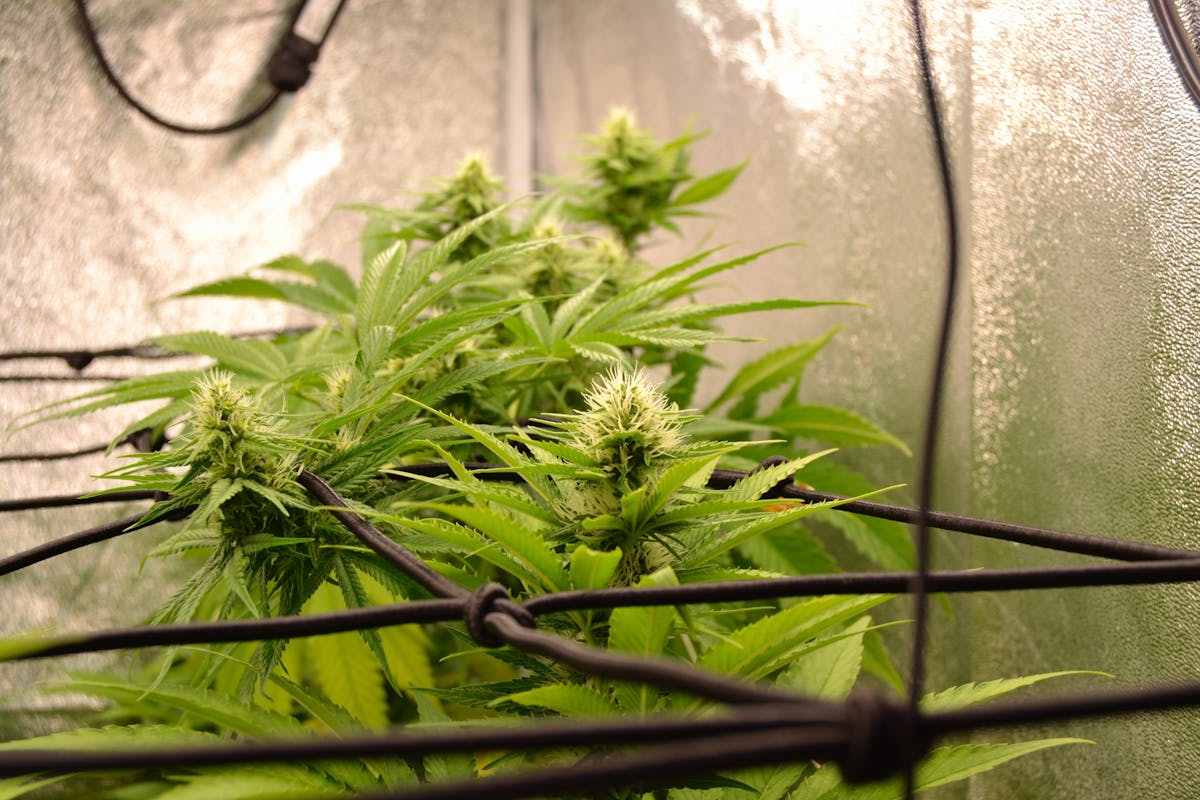
Run the light at full power, every day, all five weeks. You are photon-limited, not nutrient-limited. Then guard the humidity like it is the only thing that matters — because now it is.
At a glance
You are light-limited. This changes everything.
The definitive study ran flowering cannabis from 120 to 1800 PPFD at ambient CO2 — 437 ppm, no enrichment. Dry inflorescence yield rose linearly the whole way, 116 to 519 g/m², a 4.5× increase with no plateau. The authors: even at ambient CO2, photon availability was still limiting whole-canopy photosynthesis. A second trial confirmed it: +4.6 g per plant for every extra 100 PPFD.
This kills the common claim that you need CO2 above 800–900 PPFD. You do not. And it means every photon you leave on the table below your fixture’s maximum is forfeited yield.
Where that puts you: at ~1040 PPFD you are at 58% of the tested ceiling. Reaching 1800 in a 2×4 would need roughly a 475–500W fixture. Your 280W physically cannot get there. That is fine — it just means light, not nutrition or genetics, is your binding constraint. Run click 10 every day of weeks 3 through 7 and stop looking for the problem elsewhere.
One thing more light does not buy you: potency. Measured across the full 120–1800 range, there were no intensity effects on cannabinoid concentration at all. Terpenes are the exception — total terpenes rose 1.4×, myrcene doubled, limonene up 1.5×. So more light means more grams and richer aroma at the same percentage THC.
Defoliation — the honest answer
The only controlled cannabis study tested eight architecture manipulations, including systematic fan-leaf removal and lollipopping, against untouched controls on two cultivars. Result: no reliable increase in total yield. The measurable benefit was cannabinoid standardisation — more uniform concentration top to bottom, from better light penetration.
Schwazzing has no published controlled data whatsoever. It is a commercial protocol promoted through a book and never validated in a trial. Every defoliation study in comparable crops — tomato, soybean, strawberry, sugar beet — runs neutral to negative, because removing leaves removes the source tissue that fills the flower.
For you specifically: you are photon-limited, not penetration-limited the way a 1000W grower is. Stripping leaves removes source capacity you cannot afford. Tuck rather than cut, and remove only leaves physically buried inside colas — and do that as a bud-rot intervention, which is a defensible reason, not as a yield play, which is not.
Do this
- Run click 10 every day, weeks 3 through 7.
- Buy the HYDRONE 5 ($139) at the flip.
- Step RH down 5 points per week from week 4.
- Keep the bottom S6 aimed under the canopy.
- Inspect the six densest colas daily from week 5.
- Keep cal-mag in every flower feed (Athena CaMg, low dose — your tap is Ca-rich).
- Verify the tent is at negative pressure.
- Lollipop the bottom 25% BEFORE week 3.
Don’t
- Don’t dim to “reduce stress.”
- Don’t foliar spray anything after week 3.
- Don’t let the fans cycle off in the dark.
- Don’t chase a late nitrogen boost.
If this happens
| Bud rot found | Cut 4–6″ below the site, bag it inside the tent before removing, sterilise shears between cuts, drop RH 10 points, raise airflow. No spray. Do not try to salvage. |
| White talc-like dust on fan leaves | Powdery mildew. Remove those leaves, RH to 45%, boost airflow. No fungicide on flowers this late. |
| Interveinal chlorosis with rusty spots on UPPER growth | Calcium or magnesium. Raise cal-mag to 13 mL/10L, verify pH has not drifted below 5.5. |
| Dark green, clawed, glossy leaves at week 6+ | Nitrogen toxicity. Drop to the week-7 EC of 1.7 early. It should be fading by now. |
| Lower and interior leaves yellowing gradually | Normal. That is the intended fade. Do not correct it. |
| Yellowing on NEW upper growth, rapid or spotted | Not normal. Check pH and cal-mag. |
| Spindly new growth from the bud tips | Foxtailing — heat or light stress at the canopy. Raise the fixture 2–3″, drop day temp to 76°F. Some cultivars just do it and it is harmless. |
| White-tipped top colas | Light burn. Raise the fixture — only drop clicks if you have run out of height. |
| Humidity spike over 65% | Increase fan speed, dump the trays, run the HYDRONE 5. This is the highest-stakes single event of the whole grow. |
→ Full diagnostics: is it feeding, light, or environment?
What happens next
- Week 3Stretch ending, bracts stacking. EC 2.5, RH 55–60%, 80°F. Lock fixture height, go to click 10. Last chance to lollipop. Set up the under-canopy fan.
- Week 4Bud sites fatten and connect. Smell arrives — verify filter seal and negative pressure. EC 2.6 peak. RH to 50–55%. Start the daily cola inspection habit.
- Week 5Rapid bulking. EC 2.4. RH 50%, 78°F. Colas are now dense enough to hold their own humidity — bud rot risk begins in earnest here.
- Week 6Peak density. EC 2.3. Day temp down to 74–78°F, RH 45–50%. Lower fans yellowing — intended. Judge each plant separately; your two will not finish together.
- Week 7Ripening. EC to 1.7. RH 45%. Pistils receding. Start trichome checks with a 60× loupe. Expect 8–9 weeks total, so this is ripening, not harvest.
Sources: Rodriguez-Morrison, Llewellyn & Zheng 2021 — yield linear to 1800 PPFD · Llewellyn & Zheng 2022 — 600/800/1000 PPFD, no CO2 · Danziger & Bernstein 2021 — the only controlled defoliation study · Ohio State Extension — Botrytis conditions · Punja 2023 — Botrytis in cannabis inflorescences · Athena Blended feed schedules
The original flower notes
Nothing to train, nothing to cut. Your entire job for five weeks is climate and feed — and the climate half is the harder one in your studio.
Hold 78–82°F (74–78 wks 6–7), RH 55→45% by week. At 80–84°F, correct VPD needs humidity high enough to invite bud rot — when those two fight, cool the tent, don’t raise the humidity. The full numbers are in Temp, humidity & VPD above.
Feed & water nowPK goes in and EC peaks around 2.6 in weeks 4–6. Same mix order, same 10–20% runoff, still drain to waste. Runoff EC ~300+ over inflow = salt stacking — bigger pours, same strength.
Training nowOne last pass at the start of week 3 (~day 21), then nothing. A light, targeted defoliation: leaves physically covering a bud site, and the crowded ones buried in the middle of the plant. Not a strip-down — heavy defoliation can stall a plant, and this is your first run.
Why day 21 is the line: she can grow replacement leaves during the first few weeks of flower, but not after. A leaf pulled at day 21 comes back; a leaf pulled in week 5 is gone, and so is everything it would have fed. You can always take more away — you can’t put leaves back.
There’s a second reason for you: opening the middle of the canopy is airflow, and airflow is bud-rot defence in a studio as warm as yours. That makes this pass worth doing, lightly, even if you ignore the yield argument.
Weeks 4–7: hands off. Move a fan leaf aside if it’s shading a bud, pull anything dead or yellow, and that’s all. Never top in flower — she can’t build a new tip in time.
🍂The last 2 weeks — ripen & flush · the finishCool it down, taper to EC 1.5, start checking trichomes.›
Flush or not is your call — the evidence splits. Athena’s chart prints an RO + Cleanse flush for the last three days; the only controlled trial (Rx Green 2020: 0, 7, 10 and 14 days) found no difference in yield, THC, terpenes or ash and rated the 14-day flush the harshest. Either way: taper EC to 1.5 for the last seven days and harvest on trichomes.
At a glance
The flush question — there is actual data, and it says no
A controlled trial ran 0, 7, 10 and 14 day flush periods, 12 plants per treatment, four replications, and measured yield, THC, terpenes, tissue minerals, extraction efficiency and a blind expert sensory panel on flavour, harshness and ash colour.
No significant differences in anything. Yield 97.3 g/plant average, THC 21.9% average, terpenes flat. No difference in flavour, smoothness or ash colour. Ash was black or grey across every treatment. And directionally, the 0-day flush scored best — 36% rated smooth — while the 14-day flush was rated harshest at 41.7%. Nitrogen in tissue was only 6.7% lower after fourteen days of plain water.
The physiology never made sense anyway. The claim assumes starving the plant makes it export minerals out of the buds. Remobilisation is real but it runs leaf to sink — and the buds are the sink. Nothing exits the plant. Calcium, boron and manganese barely move at all. That 6.7% nitrogen delta is the measured proof.
So what actually causes harsh smoke? Post-harvest handling. Drying too fast leaves green-leaf volatiles and coumarin in the flower — that is the hay smell, and it is a drying failure, not a nutrient one. Drying too slow or too wet gives you ammonia and mould. The smoke quality you are chasing is decided after the cut, not before it.
Reading trichomes properly
Clear → cloudy → amber. But the browning is oxidation of phenolic compounds in the gland head, accompanied by roughly eight-fold cuticle thickening — it is a maturation and oxidation marker, not literal THC converting to CBN. That common explanation is a simplification the trichome literature does not support.
Check mid-upper bracts, never sugar leaves. Sugar leaves amber first and will lie to you by a week. Maturity is asynchronous across the plant, with more stalked trichomes on the lower bract surfaces.
Pistils are more reliable than growers give them credit for. Across 25 genotypes over 119 days, total cannabinoid concentration peaked at mostly or fully amber stigmas in 22 of 25. Use pistils as the coarse signal and trichomes as the fine one.
“Amber equals couch-lock” is folklore. No controlled human-effects trial supports it, and the CBN mechanism people cite is far too slow — CBN accumulates on a multi-year timescale, not over a fortnight.
Every other sign, ranked by how much to trust it
| Trichome heads | The call. Loupe on mid-upper bracts, three or four spots — heads on one bract mature out of step with each other, so one spot is a guess. Cloudy with 5–15% amber for a daytime effect. |
| Stigmas mostly → fully amber | Strong support. Total cannabinoids peaked there in 22 of 25 genotypes — but a few peaked early, so it confirms the loupe, it does not replace it. |
| Bracts swollen, no new white hairs | Supporting. The plant has stopped building flowers. If fresh white pistils keep appearing it is not done, whatever the calendar says. |
| Heads collapsing, browning, falling off | Stop sign. That is senescence — you are past the peak. Cut now. |
| Fan-leaf fade | Weak. Yellowing mostly says you tapered nitrogen, which you did. Never harvest on leaf colour. |
| Smell peaks or shifts | Not a tool. Real chemistry — light and heavy terpenes run on different clocks — but it points nowhere you can act on. |
| The calendar | A starting guess only. Breeder says 8–9 weeks. CBD-leaning chemotypes take longer to peak — with a Cannatonic parent, your two plants may not finish the same week. Harvest each on its own loupe. |
What the “two weeks out” look changes in the bucket. Mostly cloudy, no amber yet, stigmas about half darkened: that is the batch to drop Balance and CaMg. The chart drops CaMg at week 8 — let the plant pick the week, not the chart. Everything else follows the chart as printed — Bloom steps down, PK steps up, Cleanse holds. Staged harvest: tops come off first; the lowers keep the normal mix until their heads say so.
Sources: Plants 2025 — stigma colour vs cannabinoid peak, 25 genotypes · J Cannabis Res 2023 — Punja, Sutton & Kim, trichome maturation · J Nat Prod 2016 — cannabinoid & terpene evolution by chemotype · Athena — when to harvest
Do this
- Taper to EC 1.5 for the final seven days.
- Drop RH to 45–50%.
- Scope trichomes daily from day −10.
- Prep the freeze dryer BEFORE you cut.
- Harvest the two strains separately.
- Keep Cleanse running to the end.
- Drop Balance and CaMg the batch after the “two weeks out” look.
Don’t
- Don’t run 14 days of plain water.
- Don’t judge readiness on sugar leaves.
- Don’t raise temperature to “finish faster.”
- Don’t dry the pots.
If this happens
| Whole plant yellow by day −14 | Nitrogen ran out early. Hold EC 2.0–2.5 instead of tapering — premature senescence costs weight. |
| Still deep green at day −7 | Excess nitrogen. Cut to EC 1.5 now, but harvest on trichomes regardless of colour. |
| Bud rot found late | Cut it out with a 2″ margin immediately, sterilise between cuts, drop RH to 45%, raise airflow. If it is widespread, harvest early — a slightly immature harvest beats a lost one. |
| Trichomes not ambering by day 0 | Normal. Timing is genotype-specific. Extend 5–10 days and cross-check pistil stage. |
| One plant ready before the other | Harvest independently. Do not hold one back to match the other. |
| Seeds found | Check for nanners, remove the source. Seeded bud is still usable and potency is unaffected. |
| RH spikes over 65% | Dehumidify immediately and boost airflow. This is the single highest-risk event of the last fortnight. |
| Foxtailing late | Usually heat or light stress. Lower intensity or raise the fixture. Foxtails ripen unevenly — judge on the original bud mass, not the towers. |
→ Full diagnostics: is it feeding, light, or environment?
What happens next
- D−14 to −12Last full-strength feed. Final airflow defoliation. Begin daily trichome scoping.
- D−11 to −8Hold EC. RH toward 50%. Night temp 65–68°F. Watch for Botrytis daily.
- D−7Switch to the fade — EC 1.5. Fan leaves will start yellowing. That is the point.
- D−6 to −4RH 45–50%. Assess pistil stage. Freeze dryer ready.
- D−3Final irrigation at EC 1.5. Confirm: mostly cloudy, 5–15% amber.
- D−2 to −1Optional dark period. No feed.
- D−0Harvest. Cut just before 8 PM lights-on.
Sources: RX Green Technologies flushing trial — full report · Maillard et al. — nutrient remobilisation in plants · Livingston & Samuels — trichome development and gland chemistry · Plants 2025 — stigma stage vs cannabinoid content, 25 genotypes · Plants 2025 — drying method, decarboxylation and microbial load
✂️HarvestMostly cloudy under the macro. Wet-trim.›
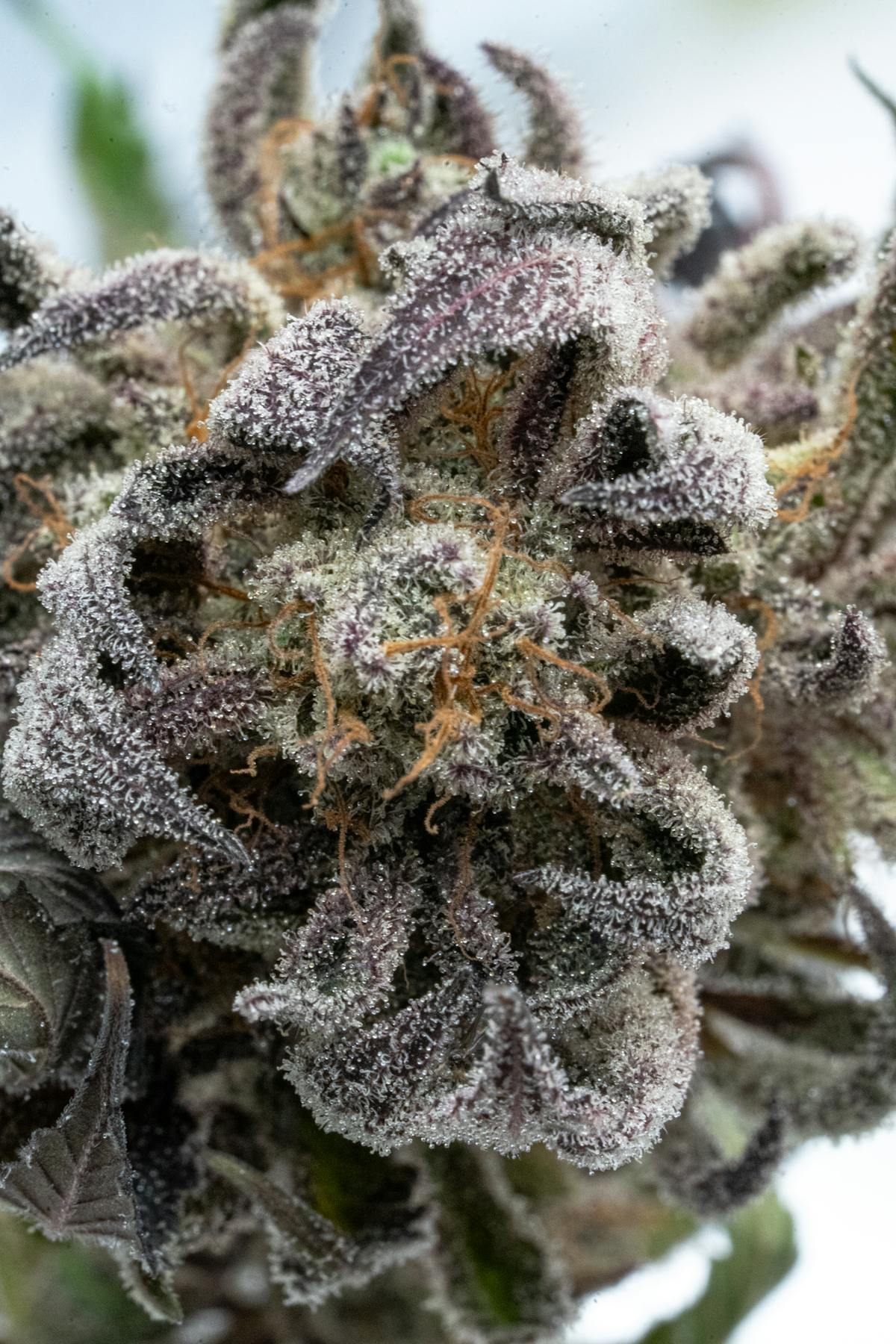
You own a freeze dryer, so wet trim — the slow-dry advantage of dry trimming is moot. Cut branch by branch at the end of the dark cycle.
At a glance
Wet trim vs dry trim — settled by the freeze dryer
The only real argument for dry trimming is that the leaf envelope buffers moisture loss and slows the dry. A freeze dryer replaces the slow-drying window entirely, so that argument evaporates. Wet-trimmed buds also pack more densely on trays, and leaving sugar leaves on complicates separation after the cycle.
Worth knowing: there is no measured terpene data comparing wet and dry trim in the peer-reviewed literature. None. Every claim on both sides is preference plus mechanism reasoning. Treat “dry trim preserves terpenes” as a hypothesis.
Freeze drying — and the finding that contradicts the marketing
Freeze drying works in three stages: freeze solid, then primary drying where vacuum sublimes ice directly to vapour, then secondary drying which pulls off bound water. Roughly three times faster than hanging.
Here is the part vendors do not tell you. A 2024 peer-reviewed volatilome study compared aggressive freeze drying against gentle tray drying and found freeze drying worse for terpenes — 45 compounds negatively affected, 28 of them terpenes, including myrcene, pinene, limonene and terpinolene. It concluded freeze drying “results in a loss of the predominant cannabis key, multi-property and aromatic compounds.” It did better preserve acid cannabinoids by avoiding decarboxylation.
The likely reconciliation: deep-vacuum, high-heat lyophilisation strips monoterpenes. Low shelf heat may not. That reconciliation is untested — but it is why you run Pharma manual control at 45–55°F shelf, not the 125°F food default. This single setting is the most consequential decision in your whole post-harvest.
Does freeze-dried flower still need a cure? Only if you run it to the beep. A Harvest Right cycle ends around 2–7% moisture, which is below 0.45 water activity — and 0.45 was measured to smoke more harshly with less terpene delivery than 0.65. Pull at ~12% instead — the jar settles at 58–62% RH, no pack needed. Boveda 62% = rescue only if you overshoot.
Don’t trust the machine’s “done” beep. Consumer units terminate on generic time, not on a moisture endpoint. Weigh the trays in and out — you want roughly 75–80% weight loss — then verify with a hygrometer in a sealed jar reading 58–62% after 12 hours.
Do this
- Cut at the end of the dark cycle.
- Work branch by branch, not whole plant.
- Wet trim straight onto the trays.
- Pre-freeze solid at −30°F before starting the cycle.
- Single layer on trays, below the rim.
- Weigh trays before and after.
- Keep the tent exhaust and carbon filter running through the entire trim.
- Save everything trichome-bearing.
Don’t
- Don’t run shelf heat at the food default.
- Don’t run to the beep.
- Don’t handle dry buds roughly.
- Don’t leave wet trimmed material sitting more than a few hours.
If this happens
| Mould found at harvest | Cut it out with a 2″ margin and discard. Sterilise shears between cuts. Freeze drying does not kill mould. |
| One plant not ready | Harvest separately, run two cycles a week apart. This is a feature of owning a small machine, not a problem. |
| Trichomes knocked off during trim | Collect the kief off the parchment. Press it or add it to a hash wash — it is not lost. |
| Buds still wet after the cycle | Re-run with 2–4 hours added. Check water activity, not appearance. |
| Buds crumbling, too dry | Seal with a 62% pack, rest 48–72 h, re-check. Very recoverable. |
| No space to dry | The freeze dryer removes this problem — but vacuum-seal and freeze any surplus while you wait for the chamber. |
| Smell during harvest | Filter and fan run the whole time. Trim in the tent. Vent the pump out a window. |
| Apartment is hot | Cycles stretch past 40 hours. Run the machine in the coolest room you have. |
Sources: Freeze drying vs tray drying — volatilome study · ASTM D8197 — water activity standard for cannabis · Water activity and smoking quality — sensory panel · Plants 2024 — controlled atmosphere vs open-air drying · Maryland cannabis home-grow rules
The original harvest notes
Ignore the pistils — read the trichomes with your iPhone macro. Clear = too early. Cloudy = peak potency, the window you want. Amber = heavier and more sedating; a few amber is fine, mostly amber is past it for a daytime jar.
Check the buds, not the sugar leaves — leaf trichomes run ahead. Cut at lights-off or just before lights-on. Wet-trim straight into the freeze dryer trays.
Feed & water now
❄️Dry & cure · your freeze dryerFreeze-dry cool, pull at target, then jar.›
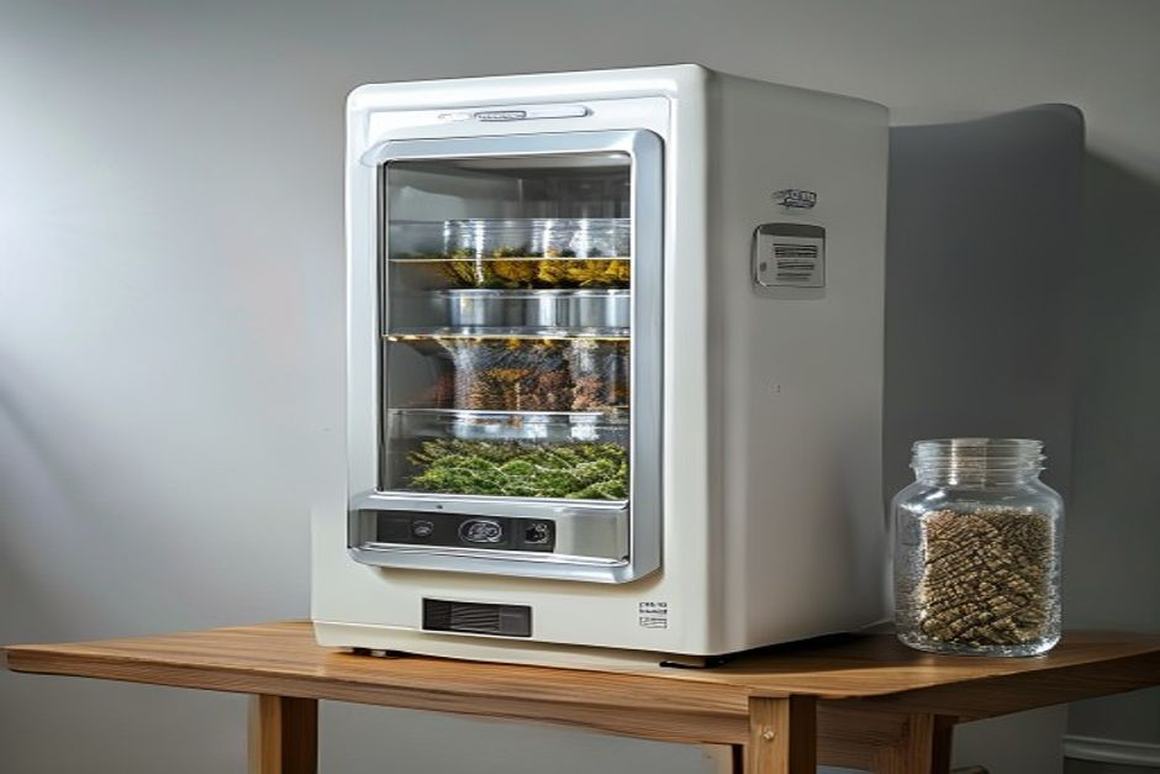
Water activity is the only number that matters. Target 0.58–0.62 — jar reads 58–62% RH. Everything else is downstream of that.
At a glance
Water activity — why the industry abandoned “moisture content”
Moisture content is total water by mass. Water activity is the free water available to microbes, on a 0–1 scale, equal to equilibrium RH divided by 100. Bound water counts toward moisture content but cannot feed mould — so moisture content does not predict spoilage and water activity does. That is why ASTM standardised it: 0.65 is the safety ceiling, 0.55 the quality floor.
And there is measured sensory data on where inside that band to sit. A study with 315 consumers and 38 trained judges compared 0.45, 0.65 and 0.85 aw. 0.65 delivered significantly more terpenes in the smoke than 0.45, was rated less irritating, produced lighter ash, and scored higher overall (54.2 versus 45.2). Sit at 0.60–0.62 — high side, under the 0.65 ceiling. Weight difference alone was 18 g per pound.
The hay smell is not chlorophyll
Chlorophyll is a large non-volatile molecule. You cannot smell it, and it does not leave the plant during cure. The actual chemistry is two things: green leaf volatiles — six-carbon aldehydes and alcohols like hexanal and hexenal, produced enzymatically from linolenic acid when tissue is wounded and senescing — and coumarin, the sweet dried-hay note released as cut tissue dries. Both are volatile and dissipate over time. That is what curing actually accomplishes on this axis. The chlorophyll story is folklore, repeated everywhere.
What curing does and does not do — measured
Terpenes only go down from harvest onward. Measured: after one week of dry and cure, myrcene dropped 55%, with pinene and limonene also falling. Meanwhile humulene appeared to double and germacrene rose 154% — but much of that “increase” is arithmetic. Monoterpenes are light and volatile and leave first; sesquiterpenes are heavy and stay, so their percentage rises because the denominator collapsed. Nothing is being created.
Cannabinoids are essentially flat through cure. Under 10% change across drying methods, no significant cure-driven shift. Curing does not increase potency. Any “stronger after cure” reading is water weight concentrating the percentage.
So what does cure genuinely do? Three things, all real: moisture equilibration across bud and stem to one uniform water activity; volatilisation of the green-leaf volatiles and coumarin, which is the hay smell leaving; and microbial stabilisation — measured yeast and mould counts held or fell through cure. What it does not do is “develop” terpenes or build cannabinoids.
CBN, for the record: the CBN-to-THC ratio reaches 2.5% at one year and 9.4% at three. It forms on a multi-year timescale. Nothing you do in a four-week cure moves it.
Aspergillus matters more than Botrytis
Botrytis ruins the bud. Aspergillus can hurt you. Several species are opportunistic human pathogens, the spores survive combustion, there are over 24 documented cases of cannabis-acquired aspergillosis including the only documented cannabis-related deaths, and a CDC analysis found cannabis users 3.5× more likely to acquire a fungal infection. Oregon flower failed Aspergillus testing at 8% in 2023.
It is frequently invisible. A clean-looking bud can be contaminated. This is the real reason to respect the 0.65 ceiling rather than eyeballing it — and the reason a jar with mould gets discarded, not re-dried, washed or extracted. Mycotoxins and spores survive all three.
Do this
- Buy a water activity meter, or at minimum a calibrated hygrometer in the jar.
- Target 0.58–0.62, not 0.55.
- Pull the freeze dryer short of its own “done” call.
- 62% pack = rescue only.
- Cure in glass, dark, filled about 75%.
- Store long-term in the fridge, vacuum-sealed or Mylar.
Don’t
- Don’t dry with heat.
- Don’t point a fan at the buds.
- Don’t trust the snap test.
- Don’t use citrus peel or bread to rehydrate.
If this happens
| Crumbles to dust, under 0.55 | Over-dried. 62% pack in a sealed jar, 5–14 days. Handle only after 48 h. |
| Jar fogs, over 0.68 | Under-dried or core rebound. Open 2–4 h/day in a 55% space until 0.62. Check daily — the mould window is about 48 hours. |
| Hay or cut-grass smell | Residual green leaf volatiles and coumarin. Normal at weeks 1–2. If still there past week 4, it dried too fast and is largely unrecoverable. |
| Visible mould in the jar | Water activity exceeded 0.65. Discard the jar. Do not salvage by re-drying, washing or extracting. Check every other jar and drop them all to 0.60. |
| Ammonia smell | Anaerobic bacterial breakdown — too wet and not burped. Dry back to 0.62 immediately; if it persists past 48 h, discard. |
| Uneven dryness between buds | Dense colas versus airy tops. Jar sizes separately and let them equilibrate 72 h before judging. |
| No smell at all | Monoterpenes are gone — fast or hot dry, or genetics. Not fixable this run. Next time: 45–55°F shelf, pull at ~12%, target 0.62. |
| Cultivars drying at different rates | Expected and large — in one trial two cultivars held 45% and 16% water after identical 14-day drying. Measure, never follow a calendar. |
What happens next
- Freeze dry — D0Cut, wet trim, single layer on trays, buds not touching. Pre-freeze 1 h at −20 to −30°F.
- D0–D1Run at 45–55°F shelf, Pharma manual. Pull at ~12% moisture, short of the done call.
- D1–D10Jar. Settles 58–62% RH — 62% pack only if it reads low. Burp every 2–3 days.
- D10–D14Ready. No extended cure needed chemically — the jar time was equilibration.
- Machine down?Hang whole branches 60–68°F / 60→55% RH, 10–14 d, then jar.
Sources: ASTM D8197 — water activity standard · Water activity and smoking quality — sensory data · Plants 2025 — drying method, decarboxylation, microbial load · Plants 2024 — controlled atmosphere vs open air, cultivar variance · Green leaf volatiles — the real cut-grass chemistry · Medicinal Genomics — Aspergillus risk in cannabis · UNODC — cannabinoid degradation in storage
The original dry & cure notes
Run the Harvest Right on the Pharma firmware, shelf 45–55°F — never the 125°F food setting, it cooks the terpenes off. Pull at ~10–12% moisture; a jar should settle at 58–62% RH.
Freeze drying replaces the hang-dry, not the cure. Jar it — Boveda 62% = rescue only, never the primary dryer — and burp it for a few days. That patience is what turns good into great.
Every number here is set to your 2×4 coco drip — your gear, your feed, your method.
Maryland home-grow limit: 2 plants · keep the tent locked.
Photos: Pexels (free license) · veg photo Plantlady223 / Wikimedia, CC BY-SA 4.0 · drip & dryer images: AI illustrations matched to this rig